



A Tale of Two Planets
For as long as we have looked to the skies, the contrast between Earth and Mars has been a source of fascination. Earth is large, wet, and teeming with life. Mars, its smaller sibling, is just one-tenth of Earth's mass, appearing dry, dusty, and geologically
quiet. For decades, scientists have grappled with this disparity, known as the 'Mars Problem'. Early models of how solar systems form predicted that Mars should be much larger, perhaps even similar in size to Earth and Venus. The fact that it isn't has remained one of the biggest puzzles in planetary science, prompting researchers to look for a better explanation of how the rocky inner planets came to be.
The Old Story of Planet Building
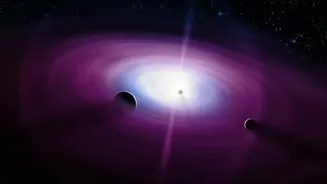
Traditionally, scientists believed planets grew in a relatively straightforward way. In the vast, rotating disk of gas and dust around the young Sun, tiny particles clumped together to form kilometre-sized bodies called 'planetesimals'. These planetesimals then collided and merged over millions of years, gradually building up into the planets we see today. This is known as the planetesimal accretion model. While it explains many features of our solar system, it consistently struggles to produce a small Mars. Simulations based on this model almost always result in a Mars that is far too massive, suggesting some crucial piece of the story was missing.
A New 'Hybrid' Recipe
Recent research, particularly from a team at the University of Copenhagen, proposes a more nuanced 'hybrid' model. This theory suggests planets aren't built by just one process, but a combination of two: the classic smashing together of large planetesimals, and a second process called 'pebble accretion'. Pebble accretion is when larger, growing protoplanets sweep up smaller, centimetre-sized particles—the 'pebbles'—from the surrounding disk of gas and dust. The new model argues that the proportion of these two ingredients was fundamentally different for Earth and Mars, leading to their vastly different outcomes.
Earth's Path: Built from Pebbles
According to the hybrid model, Earth's formation was dominated by pebble accretion. The study suggests at least 75% of our planet's mass came from large planetary embryos, or protoplanets, that grew massive by efficiently gathering up a steady stream of pebbles. These pebble-fed giants eventually collided to form the Earth we know. The remaining 25% of its mass is thought to have come from the more violent collisions with larger planetesimals. By analysing the chemical makeup of Earth's mantle, particularly the presence of certain volatile elements like zinc and potassium, researchers were able to create a chemical fingerprint that points to this pebble-heavy formation history.
Mars's Story: A Planet of Planetesimals
The formation recipe for Mars appears to be the complete opposite. The same chemical analysis and computer modelling suggest that roughly 75% of the Red Planet's mass was built from the direct, chaotic collisions of planetesimals. Only about a quarter of its mass came from the gentler accumulation of pebbles. This difference is crucial. A formation route dominated by planetesimal collisions is less efficient at growing a large planet quickly, especially if the building blocks in that region were sparse. This helps explain why Mars stopped growing early and ended up so much smaller than its neighbour.
Why This Changes Everything
This hybrid model is a significant step forward because it resolves the 'Mars Problem' in a more elegant way than previous theories, such as the 'Grand Tack' which required the giant planet Jupiter to migrate dramatically through the solar system to stunt Mars's growth. The new research suggests the answer lies not in external interference, but in the very ingredients each planet was made from. As one researcher put it, it's surprising that two planets formed side-by-side could have such different histories. This understanding has profound implications, not just for our own solar system, but for the search for habitable exoplanets. It shows that even in the same cosmic neighbourhood, planets can follow dramatically different evolutionary paths, shaping their potential to host atmospheres, water, and life.