



A Giant Pool for a Lunar Mission
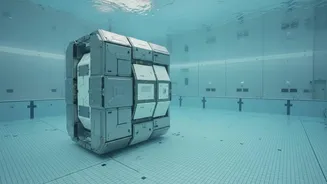
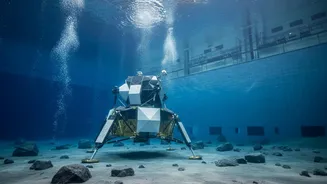
At first glance, practicing for a moonwalk underwater seems strange, but NASA's Neutral Buoyancy Laboratory (NBL) in Houston is one of the world's most effective environments for simulating space missions. The enormous indoor pool, measuring over 60 meters
long and 12 meters deep, holds 6.2 million gallons of water. For decades, it has been the primary training ground for astronauts learning to perform spacewalks outside the International Space Station. Now, its purpose has expanded to prepare for the unique challenges of working on the Moon. By using specially weighted spacesuits and a team of support divers, the facility can simulate the one-sixth gravity astronauts will experience on the lunar surface, allowing them to get a feel for movement and tasks in a lower-gravity environment.
Meet the Scientist-Divers
This milestone training session was headlined by two of NASA's exploration geologists and Artemis science officers, Trevor Graff and Angela Garcia. This was the first time that two geologists were suited up at the same time for a lunar geology training run in the NBL. Their expertise is critical to the Artemis program's core goal: conducting meaningful science on the lunar surface. Unlike the Apollo missions, which had limited time for scientific discovery, Artemis aims to establish a sustainable presence, with a heavy emphasis on geological research. Graff and Garcia's training marks a shift toward ensuring that future moonwalkers are not just pilots and engineers, but also highly trained field scientists ready to maximize every moment on the surface.
Training for a New Lunar Landscape
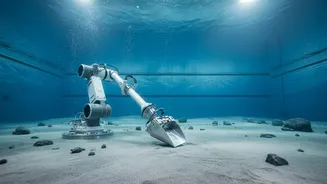
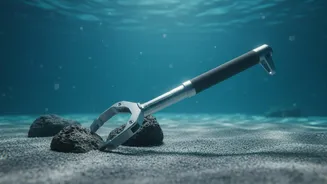
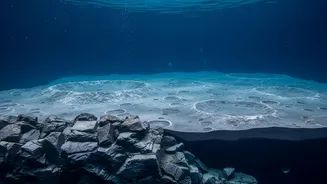
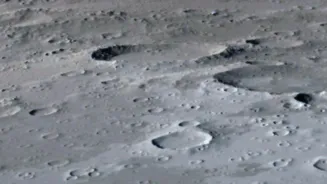
The training was far more than just a swim in a bulky suit. A section of the NBL was outfitted with soil and rocks to simulate the Moon's surface. Graff and Garcia practiced kneeling, using geological tools for sample collection, and moving across the simulated lunar floor. A crucial part of the exercise involved replicating the difficult lighting conditions at the Moon's South Pole, the target destination for upcoming Artemis missions. At the pole, the Sun hangs low on the horizon, creating extremely long and deep shadows that can obscure the landscape. By training in similar low-angle lighting, the team can develop strategies and test equipment to ensure astronauts can navigate and perform their scientific duties safely and effectively in this challenging environment.
From Apollo's Flags to Artemis's Science
This new focus on complex scientific tasks differentiates Artemis training from that of the Apollo era. While Apollo astronauts did receive geology training, their surface excursions were brief. The Artemis missions are planned to be longer and more ambitious, requiring astronauts to do everything from deploying sophisticated scientific payloads to identifying and collecting high-value geological samples. This underwater test saw the science officers practice deploying a mock lunar payload, a task representative of the advanced experiments planned for the Moon. The training helps NASA refine procedures for how astronauts will move, set up habitats, and conduct detailed scientific investigations far from Earth. This preparation is essential for turning the promise of lunar science into reality.
What This Means for the Return to the Moon
This exercise represents a tangible step forward in NASA's detailed preparations for landing humans back on the Moon. It's one thing to design tools and plan missions on paper; it's another to have suited-up scientists test those very procedures in a simulated off-world environment. The data and feedback gathered from this training will directly inform the development of spacesuits, tools, and the operational timeline for missions like Artemis IV. As NASA continues to overcome the technical hurdles of developing and selecting lunar landers, this parallel work on training development ensures that when the hardware is ready, the crew will be too. Each underwater session helps build a foundation of knowledge and practice, ensuring that the next astronauts to walk on the Moon are the most prepared and scientifically capable explorers in history.