




First, What Is a Tidal-Disruption Event?
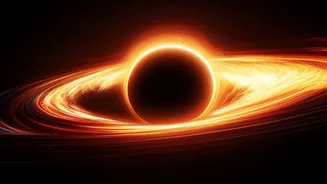
Imagine a star minding its own business, drifting through the cosmos. If it strays too close to a supermassive black hole, the immense gravity of the black hole pulls on the star with incredible force. This gravitational pull is so much stronger on the side
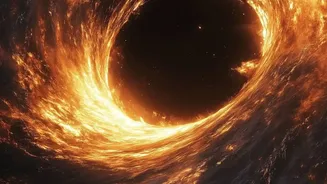
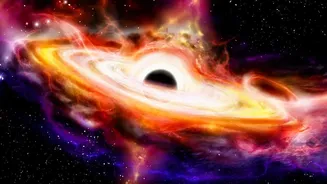
of the star closer to the black hole than on the far side. This difference in force, known as a tidal force, stretches the star vertically while compressing it horizontally until it's torn apart into a long, thin stream of gas, a process astronomers delightfully call "spaghettification". As this stellar material swirls around the black hole like water down a drain, it heats up intensely and releases a brilliant flare of light that can outshine the entire host galaxy. This dramatic flash is the tidal-disruption event (TDE) that telescopes can detect millions of light-years away.
A Puzzle in an Unexpected Place
Until recently, astronomers have almost exclusively found these TDEs right where you'd expect them: at the heart of galaxies. This is because the biggest black holes, the supermassive ones with millions or billions of times the mass of our sun, are believed to anchor the centres of most large galaxies, including our own Milky Way. The dense concentration of stars in the galactic core makes it the most likely place for an unlucky star to have a fateful encounter. So, when astronomers using the Zwicky Transient Facility in California spotted a bright flare in November 2025, they were puzzled. The flare had all the hallmarks of a TDE, but it wasn't at the centre of its galaxy. It was in the quiet outskirts, more than 30,000 light-years away from the core of a galaxy 750 million light-years from Earth.
Confirming the Discovery
The initial alert was intriguing, but needed verification. That's where NASA's Neil Gehrels Swift Observatory came in. By observing the event in ultraviolet light, Swift helped confirm the nature of the explosion. The stellar gas was heated to blistering temperatures around 30,000 degrees Celsius, and at its peak, the flare was as luminous as 10 billion suns. These details, combined with observations from other ground-based telescopes like the SOAR telescope in Chile, allowed scientists to confidently label the event, named TDE 2025abcr, as a genuine tidal disruption. It was the most distant TDE ever confirmed away from a galactic centre, proving that massive black holes can lurk where they are least expected.
The Case of the Wandering Black Hole
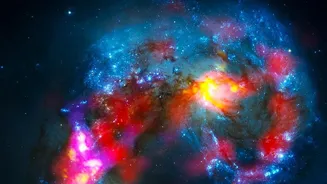
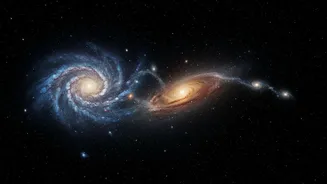
So, what was a massive black hole, estimated to be a million times the mass of the sun, doing in the galactic wilderness? Black holes themselves are invisible, so we can only find them when they interact with something else, like a star. This TDE acted like a flare, momentarily revealing the location of a hidden giant. The leading theory is that this is a "wandering" black hole. Scientists believe that when galaxies collide and merge, their central black holes can engage in a complex gravitational dance. Sometimes, one of the black holes can be violently ejected from the newly formed galaxy's core and sent roaming through its outer regions. Another possibility is that a large galaxy is in the process of consuming a smaller dwarf galaxy, and this black hole is the dense, surviving core of that smaller galaxy.
Why This Finding Is a Game Changer
This discovery is more than just a cosmic oddity; it's a crucial piece of the puzzle in understanding how galaxies and black holes evolve. It provides the strongest evidence to date that wandering black holes, long predicted by theories, really do exist. Furthermore, it validates a new method for finding these invisible giants. Researchers are now using artificial intelligence algorithms to specifically search for the signatures of off-centre TDEs in the vast amounts of data collected by sky surveys. By finding more of these wandering black holes, astronomers can better understand the violent history of galactic mergers and build a more complete census of the universe's most massive objects. The quiet suburbs of galaxies, it turns out, might be hiding some very big secrets.