





A World We Thought We Knew
For decades, Pluto was little more than a fuzzy point of light, a tiny and distant world presumed to be geologically dead. With surface temperatures plunging to around -220 degrees Celsius, it seemed impossible for it to be anything but a solid ball of ice
and rock. That all changed in 2015 when NASA's New Horizons spacecraft flew past the dwarf planet, sending back images that stunned scientists. Instead of a static, cratered landscape, New Horizons revealed soaring ice mountains, vast nitrogen glaciers, and a surprisingly young surface, hinting at ongoing geological activity. The most compelling mystery was that this small world, so far from the sun's warmth, wasn't frozen solid.
The Clues in the Ice
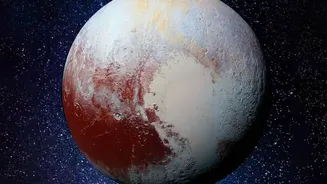
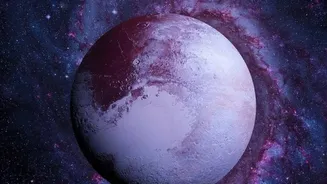
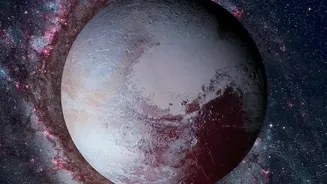
The strongest evidence for a subsurface ocean lies in a giant, heart-shaped feature on Pluto's surface named Tombaugh Regio. The western lobe of this heart, a vast basin called Sputnik Planitia, is key. Scientists noted that the basin's location suggests a mass concentration, something heavy that oriented the entire dwarf planet. A deep liquid ocean would be denser than ice and could provide this gravitational anomaly. Furthermore, the surface of Pluto is covered in fractures and faults. Some of these cracks suggest the surface has expanded over time. This is a crucial clue, as water is one of the few substances that expands when it freezes. A slowly freezing subsurface ocean would push outward on the ice shell, cracking the crust in a specific way that scientists have now observed. The lack of features caused by compression further strengthens the case that Pluto started warm and has been partially freezing ever since.
How Can an Ocean Survive?
The biggest question is how a liquid ocean could persist for billions of years on such a small, cold world. The answer likely lies deep inside Pluto. While it's too far from the sun for solar heating to play a role, Pluto's rocky core is thought to contain radioactive elements. The slow decay of these elements over billions of years could generate just enough residual heat to keep the bottom of the ice shell from freezing completely. Think of it as a weak but incredibly long-lasting planetary radiator. Scientists also believe the ocean itself is not pure water. It is likely very salty and may contain ammonia, which would act as a powerful antifreeze, lowering the freezing point of the water significantly. Recent models suggest this ocean is buried beneath a thick ice shell, perhaps 40 to 80 kilometers deep, which acts as a perfect insulator, trapping the heat within and protecting the ocean from the extreme cold of the surface.
Not Water, But Liquid Nitrogen
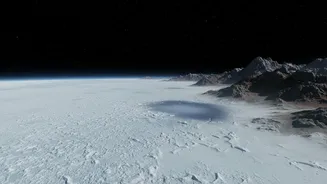
While a subsurface water ocean is the leading theory, a very recent discovery in August 2026 added another twist. Researchers analysing New Horizons data found features on the northern edge of Sputnik Planitia that look like they were recently wetted by a liquid. Given Pluto’s extreme cold, this liquid wouldn't be water. Instead, scientists believe it is liquid nitrogen that has seeped up from below the vast nitrogen glacier. This doesn't disprove the water ocean theory; it just adds another layer of complexity. It suggests that heat from Pluto's interior could be melting nitrogen ice at the base of the glacier, which then erupts to the surface through cracks. It's the first evidence of any kind of recently flowing liquid on Pluto's surface and proves the dwarf planet is still geologically active.
A Universe of Oceans
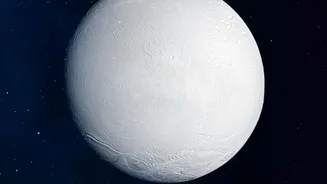
The confirmation of an ocean on Pluto would fundamentally change our understanding of where liquid water—and potentially life—could exist. We already have strong evidence for subsurface oceans on moons like Jupiter's Europa and Saturn's Enceladus, but those worlds are warmed by the gravitational pull of their giant parent planets. Pluto has no such external heat source. If a small, isolated world like Pluto can maintain a liquid ocean for billions of years, it implies that countless other icy bodies in the Kuiper Belt and beyond could also be 'ocean worlds'. This vastly expands the number of potential habitats in our solar system, suggesting that the conditions for life might not be as rare as we once thought.