



A Celestial Lion's End
Before we dive in, it’s worth noting that the nickname 'Lion Nebula' can refer to two different cosmic objects. The subject of Webb's latest portrait is NGC 2392, a planetary nebula. This isn't a nursery for new stars, but rather the beautiful, glowing
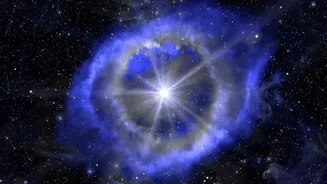
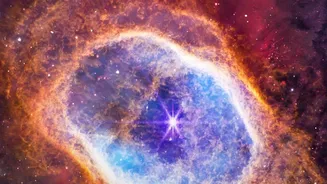
shroud of a star much like our own sun in its final evolutionary stages. As the star exhausted its fuel, it shed its outer layers of gas into space. What remains at the centre is a white dwarf—the incredibly hot, dense core of the once-mighty star. This stellar remnant, appearing like the button nose of a lion, is now illuminating and sculpting the very material it cast off thousands of years ago, creating the spectacle we see today. The entire structure is a fleeting cosmic moment; astronomers estimate it will completely disperse in about 10,000 years.
Anatomy of a Cosmic Roar
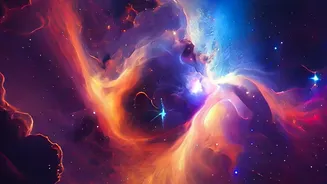
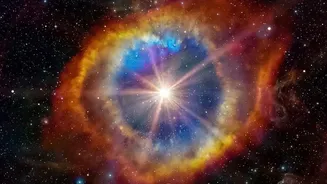
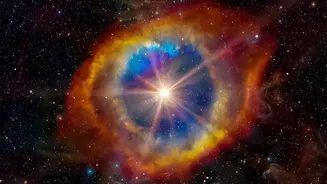
Webb's new image, a composite from its near-infrared and mid-infrared cameras, gives us a front-row seat to this cosmic process. The nebula's most striking features form a shape uncannily like a lion's head. The 'face' is a cavernous bubble of glowing gas. This isn't a solid surface, but an expanding shell being pushed outward by the intense energy from the central white dwarf. Surrounding this is the 'mane,' a thicker ring of material that appears more filamentous. This mane is composed of dust and dense clumps of gas that have, so far, survived the blistering radiation. These clumps even create 'shadows' behind them, protecting material further out from the star's energetic blast. While the NASA/ESA Hubble Space Telescope imaged this object in 2000, Webb's infrared vision cuts through the haze to reveal these structures with far greater clarity, distinguishing the wispy gas from the denser dust.
The Science of the Glow
The headline's focus on 'ionised gas' points to the key science story here. So, what is it? In simple terms, gas becomes ionised when it's superheated by intense energy, causing atoms to lose their electrons. In the Lion Nebula, the central white dwarf is so hot that it bombards the surrounding gas with powerful ultraviolet radiation. This radiation strips electrons from the hydrogen atoms, 'ionising' them. When these electrons eventually recombine with the atoms, they release energy in the form of light. This is what makes the nebula glow. The vibrant colours in Webb's image are essentially a map of this process. The light purple and pink bubble of the lion’s face shows where the gas is fully ionised and glowing brightly, telling astronomers exactly where the dying star's energy is having the most dramatic effect.
Why Webb Sees It Best
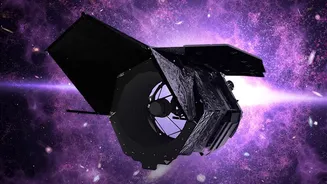
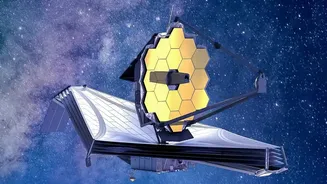
The James Webb Space Telescope is uniquely equipped to tell this story. Its powerful infrared instruments are designed to detect the specific signatures of different gases and dust. While Hubble sees primarily in visible and ultraviolet light, Webb peers into the infrared spectrum. This allows it to see the faint heat glow from cooler dust in the 'mane' and differentiate it from the hot, ionised gas of the 'face'. This ability to separate the different components of the nebula provides a much clearer picture of the physics at play. We can see which parts are being destroyed by the star's radiation and which are dense enough to survive. By studying these interactions, scientists can better understand how dying stars return heavy elements, cooked up during their lifetime, back into the cosmos to form the next generation of stars and planets.