






When we think of saving Earth from an asteroid, we often picture a heroic, last-minute blast. But new research shows the reality is far more complex, revealing that an asteroid's lumpy shape means that where you hit it matters immensely.
The Challenge of Planetary Defense
The idea of planetary
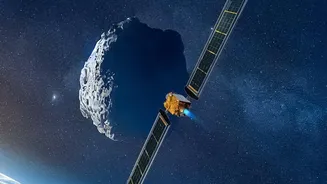
defense isn't just science fiction; it's an active field of scientific research. Agencies like NASA and ESA are constantly tracking Near-Earth Objects (NEOs) and developing methods to protect our planet from a potential collision. While small meteorites burn up in our atmosphere daily, larger asteroids have caused catastrophic events in Earth's history, like the impact that wiped out the dinosaurs. The 2013 Chelyabinsk event, where a 19-meter asteroid exploded over Russia with the force of an atomic bomb, served as a stark reminder of the threat. To counter this, scientists have explored several deflection techniques. One of the most tested is the 'kinetic impactor', where a spacecraft is deliberately crashed into an asteroid to nudge it onto a different, safer trajectory. NASA's DART mission in 2022 successfully demonstrated this by altering the orbit of the asteroid moonlet Dimorphos. Another proposed method, for more urgent threats, involves a 'stand-off' nuclear detonation, where the X-rays from the blast vaporize part of the asteroid's surface, creating a powerful push.
The Problem with Perfect Spheres
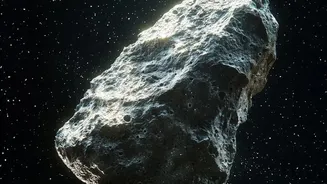
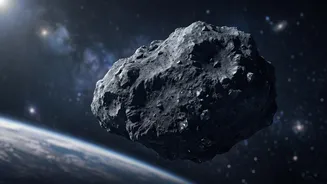
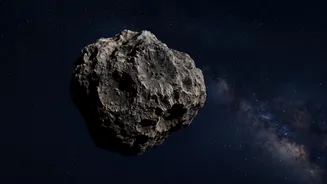
A significant hurdle in planning these missions is that asteroids are not the perfect spheres often seen in early simulations. Real-world space rocks are lumpy, potato-shaped objects with uneven surfaces, ridges, and craters. This irregularity has long been a challenge for researchers. Previous computer models often had to make a choice: either accurately render an asteroid's complex 3D shape or perform highly detailed physics calculations of the impact. Doing both at the same time was computationally overwhelming. This simplification to smooth spheres made the math easier but failed to capture how a real, lumpy asteroid would react to a powerful push. Researchers at Sandia National Laboratories, led by physicist Nathan Moore, recognized this gap and developed a new algorithm that is over 1,600 times faster, finally allowing them to combine realistic shapes with high-fidelity physics.
A Fivefold Difference in Effectiveness
The new simulations, published in the journal Icarus, delivered a stunning confirmation of why shape matters so much. The research team modeled how irregularly shaped asteroids—like Golevka, Bennu, and Itokawa—would react to a simulated X-ray blast from different directions. The results were dramatic. For one simulated asteroid, a blast from one direction produced a change in velocity of 3.9 millimeters per second. However, when the blast hit the same asteroid from a different angle, the change was only 0.8 millimeters per second—a nearly fivefold difference in deflection effectiveness. The asteroid's rotation was even more sensitive to the impact direction, changing by a factor of 17 in one case. 'We expected aim to matter,' said lead researcher Nathan Moore. 'What surprised us was how much.' This variance is caused by the asteroid's topography; its ridges and slopes change how material vaporizes from the surface, altering the direction and magnitude of the resulting push.
Smarter Defense for a Safer Future
These findings have profound implications for future planetary defense missions. They show that simply hitting a threatening asteroid isn't enough; we need to hit it in the right spot. 'Pick the right side and you win. Guess wrong and it could be a bad day,' Moore explained. This research underscores the critical need for detailed reconnaissance of any potential threat. Before launching a deflection mission, we would first need to send a probe to create a high_resolution 3D map of the target asteroid. This data could then be fed into these advanced simulations to calculate the optimal point of impact to maximize the nudge and minimize the risk of the asteroid breaking into multiple fragments, which could create a new set of problems. While the DART mission proved the kinetic impactor concept, this new research provides a crucial tool for refining another potential defense method, making it more predictable and reliable.