



What Exactly Is This New Train?
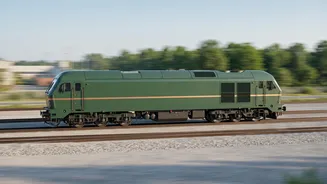
On September 27, 2026, India's first LNG-powered train was flagged off from Sabarmati in Gujarat. It's not a train that runs purely on LNG, but rather a dual-fuel model. Specifically, two 1,400 HP Driving Power Cars (DPCs) on a Diesel-Electric Multiple
Unit (DEMU) train have been converted to run on a mix of diesel and LNG. This system allows the engine to substitute approximately 40% of its diesel consumption with the cleaner-burning natural gas. The inaugural run took place between Sabarmati and Mahesana Junction with an eight-coach, non-AC chair car train. This technology provides crucial flexibility, as the train can still operate fully on diesel if LNG is not available, ensuring operational reliability.
The Driving Force: Moving Away from Diesel
For years, Indian Railways has been on a mission to slash its massive diesel bill and environmental footprint. The organisation has set an ambitious target to achieve net-zero carbon emissions by 2030 and eliminate diesel use entirely. While rapid electrification has been the primary strategy, with nearly 99.6% of the broad-gauge network now electrified, some sections and types of trains like DEMUs remain dependent on diesel. DEMUs, which have their own power source in Driving Power Cars, cannot be pulled by electric locomotives, making them prime candidates for alternative fuel solutions. This LNG project is a pragmatic step to decarbonise these specific routes and operations where full electrification is not yet feasible.
The Environmental and Economic Payoff
The switch to LNG offers compelling benefits. Environmentally, LNG burns much cleaner than diesel, significantly reducing emissions of harmful pollutants like nitrogen oxides (NOx), sulfur oxides (SOx), and particulate matter. It is also expected to cut carbon dioxide (CO2) emissions by up to 20-30%. Economically, the move is just as attractive. Based on trial data, Indian Railways estimates that using LNG could result in annual savings of around ₹23.9 lakh for an eight-coach train. With LNG prices often being more stable and lower than diesel, this technology promises to lower operational costs without compromising the engine's power or performance.
How the Technology Works
The conversion, carried out at the Sabarmati Integrated Coaching Depot, involved retrofitting the DPCs with sophisticated cryogenic fuel systems. Each DPC is now equipped with a 2,200-litre insulated tank designed to store LNG at a frigid -162°C. This tank holds about 950-1,000 kg of usable LNG, providing enough fuel for a range of approximately 444 km per DPC. Before the official launch, the converted power cars underwent over 2,000 kilometres of extensive field trials to ensure their performance, safety, and reliability under real-world operating conditions.
Challenges and the Road Ahead
While promising, the wider adoption of LNG faces hurdles. The most significant is the need for dedicated infrastructure for LNG storage and refueling along railway routes, which requires substantial upfront investment. Safety is another critical consideration, as handling cryogenic fuel demands specialized systems and protocols. However, this LNG train is part of a broader strategy that also includes the recent launch of India's first hydrogen-powered train. While the hydrogen train represents a more radical leap toward zero-emission travel, the LNG dual-fuel system is seen as a crucial transitional technology. It allows Indian Railways to immediately reduce emissions and costs on its existing fleet, serving as a practical bridge to a fully green transportation network.