



A Portrait of Celestial Pairs
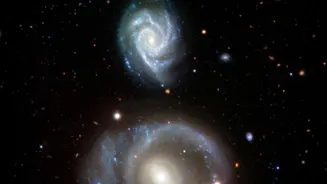
The image, which gained attention as NASA's Astronomy Picture of the Day for August 10, 2026, presents a captivating scene featuring six distinct galaxies seemingly arranged in three pairs. At first glance, the composition tells a dramatic story of interaction.
The bottom two galaxies, NGC 4622A and NGC 4622B, are indeed locked in a gravitational embrace, their shapes distorted as they slowly merge into a single, larger galaxy over the next billion years or so. This type of galactic collision, while taking eons, is a fundamental process in the universe, leading to bursts of star formation and the growth of massive galaxies like our own Milky Way.
The Great Cosmic Deception
The true intrigue of the image lies with the other four galaxies. The pair in the middle appears close enough to be interacting, but astronomers have determined this is likely not the case. Their relative speeds suggest they are merely passing ships in the cosmic night, not partners in a gravitational dance. The top pair is even more deceptive. While they look like neighbors, they are likely not interacting at all in this moment. This is a classic case of a chance alignment, where two objects at vastly different distances from Earth appear close together from our specific vantage point. It is a powerful reminder that a two-dimensional photograph of space can create powerful optical illusions.
Unveiling the Third Dimension
So, if we cannot trust our eyes, how do astronomers separate cosmic partners from coincidental alignments? The answer lies in measuring the universe's third dimension: depth. One of the key tools for this is redshift. As the universe expands, distant galaxies are moving away from us, causing the light they emit to be stretched to longer, redder wavelengths. By measuring a galaxy's redshift, astronomers can calculate its distance with remarkable accuracy. Another method involves searching for 'standard candles'—celestial objects like certain types of supernovae that have a known, consistent brightness. By comparing how bright they appear to how bright they truly are, scientists can determine their distance. These techniques allow astronomers to build a three-dimensional map of the cosmos, distinguishing true galactic clusters from misleading line-of-sight alignments.
A History of Deception
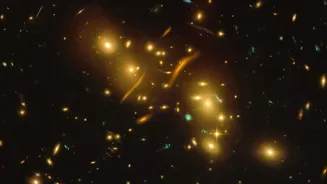
This is far from the first time the Hubble Space Telescope has captured such a cosmic illusion. In one famous instance, the telescope imaged two spiral galaxies, SDSS J115331 and LEDA 2073461, that appeared to be colliding. However, analysis revealed one galaxy is more than a billion light-years away, and the overlap was pure coincidence. In another case, what looked like a galaxy with a strange ring was actually a phenomenon called gravitational lensing, where the immense gravity of a foreground galaxy cluster bent the light from a much more distant galaxy, creating multiple distorted images of it. These events underscore the detective work required in modern astronomy.
Why Perspective Is Everything
Understanding the true relationships between galaxies is crucial. It helps astronomers accurately map the large-scale structure of the universe, often described as a 'cosmic web' of filaments and voids. Differentiating between interacting and non-interacting systems allows scientists to study how galaxies evolve. Collisions and mergers can trigger furious bursts of star formation, radically change a galaxy's shape from a spiral to an elliptical, and fuel the growth of the supermassive black holes at their centers. By correctly identifying true interactions, astronomers can build and test models of galaxy formation, piecing together the history of the universe from its earliest moments to the present day. This image of three pairs, with its mix of truth and illusion, perfectly captures the challenge and the beauty of that quest.