




Our Sun's Protective Bubble
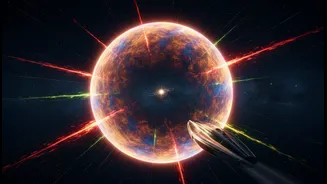
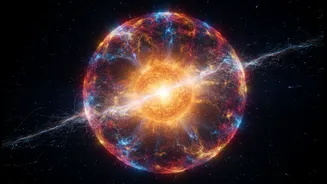
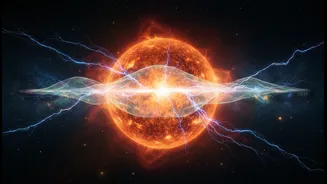
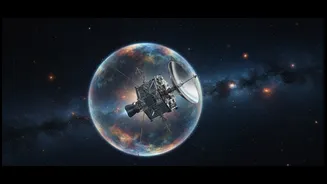
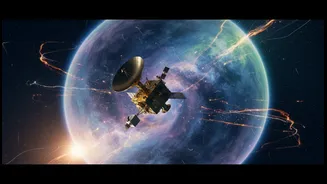
Imagine a vast, invisible shield enveloping the Sun and all its planets. That’s the heliosphere. It’s a massive bubble blown by the solar wind, a constant stream of charged particles flowing from the Sun. This bubble pushes back against the interstellar
medium—the mix of gas, dust, and cosmic rays that fills the space between stars. This protective function is crucial; the heliosphere shields us from a significant amount of harsh galactic cosmic radiation, energetic particles from distant exploding stars that could otherwise damage DNA and make life on Earth much more difficult. In a very real sense, the heliosphere helps make our solar system a habitable place.
Pioneers at the Final Frontier
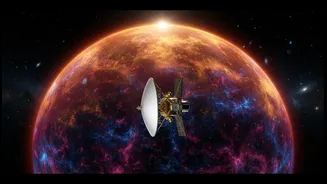
Our only direct knowledge of the heliosphere's edge comes from two remarkable relics of the 1970s: the Voyager 1 and 2 spacecraft. Originally sent to tour the outer planets, these probes just kept going. In 2012, Voyager 1 became the first human-made object to enter interstellar space, with Voyager 2 following in 2018. Their data was revolutionary, but also puzzling. They revealed that the boundary isn't a simple, smooth line but a complex, turbulent region. The shape of the heliosphere itself appears to be more of a squashed, croissant-like shape than a perfect sphere. However, the Voyagers were not designed for this mission; their instruments are old, and their power is fading, leaving many questions unanswered.
Meet the Interstellar Probe
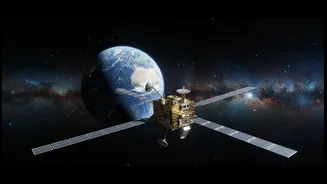
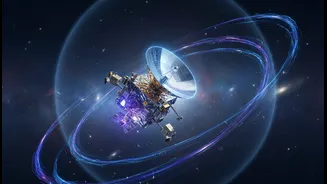
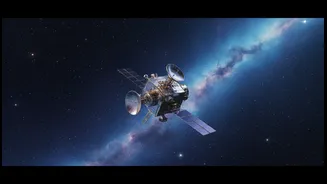
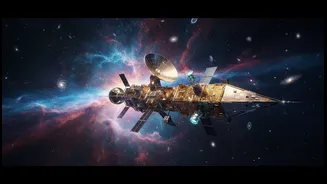
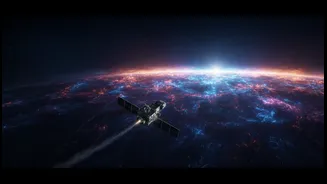
To truly understand the heliosphere, scientists believe we need to see it from the outside. This is the goal of a proposed mission concept called the Interstellar Probe (ISP). Described as “Voyager on steroids,” ISP would be the first mission specifically designed to journey through the heliosphere's boundaries and into the galaxy beyond. While missions like NASA’s IMAP, launched in 2025, are designed to map the heliosphere's boundary from near Earth, ISP would provide the first direct measurements from the other side. It would be a dedicated observatory sent to understand the heliosphere as a complete system and see how it interacts with its galactic environment.
A Mission for the Next Generation
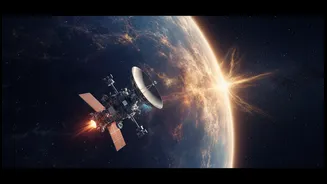
The scale of the Interstellar Probe mission is immense. The current concept proposes a launch in the 2030s aboard a powerful Space Launch System (SLS) rocket. It would use a gravity assist from Jupiter to achieve incredible speeds, allowing it to cross the heliosphere in just over 15 years—a journey that took Voyager 1 about 35 years. But its mission wouldn't stop there. Designed to operate for at least 50 years, the probe would travel hundreds of times the distance from the Earth to the Sun, looking back to capture the first-ever “family portrait” of our heliosphere from the outside. This long-term perspective is key to understanding how our bubble breathes and flexes in response to the Sun's activity and the interstellar winds.
Why It Matters for Us
Understanding our cosmic shield is more than an academic exercise. It helps us answer fundamental questions about our place in the universe. How does a star system support life? What makes a planet habitable? By studying our own heliosphere, we get a template for understanding the thousands of other star systems, or astrospheres, being discovered across the galaxy. Furthermore, a better grasp of the heliosphere’s structure and dynamics improves our ability to predict space weather. This is critical for protecting astronauts and our satellite infrastructure from dangerous radiation, especially as humanity plans for future missions to the Moon and Mars.