








The Fading Colours of History
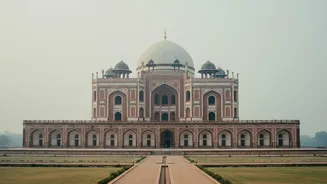
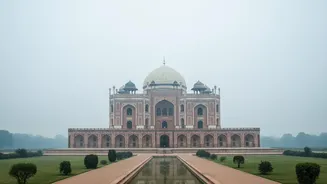
For centuries, the deep red of the Red Fort’s sandstone and the intricate patterns on Humayun's Tomb have awed visitors. Today, that vibrant colour is under assault. Scientific studies have confirmed what is becoming visible to the naked eye: dark, sooty
patches are appearing on the surfaces of these landmarks. This discolouration, sometimes described as 'black crusts', is not merely dust that can be wiped away. It is the physical evidence of a chemical attack on the stone itself, a process that is dulling the brilliance of these architectural marvels and leaving a grim patina of neglect. This darkening threatens not just the beauty of the monuments but their very integrity.
A Chemical Assault on Stone
The damage is the result of complex chemical reactions driven by pollutants in Delhi’s air. Emissions from vehicles, industrial activity, and construction dust release a cocktail of harmful substances, including sulphur oxides (SOx), nitrogen oxides (NOx), and particulate matter (PM). When sulphur dioxide reacts with moisture in the air and calcium in the stone or from airborne particles, it forms gypsum. This gypsum forms a crust that traps soot and heavy metals like lead and zinc from traffic fumes. This process, known as sulfation, effectively creates a layer of decay on the stone's surface. Studies by institutes including IIT Roorkee and IIT Kanpur have detailed how these black crusts are slowly eating away at the sandstone, causing it to erode and weaken.
From Surface Stains to Structural Threats
While the immediate impact is aesthetic, the long-term consequences are far more serious. The black crusts are not just a surface stain; they cause the stone to exfoliate, or peel away, threatening the intricate carvings and structural stability of the monuments. Researchers have found these crusts can be up to half a millimetre thick in some areas, bonding tightly to the stone and raising the risk of irreversible damage. This phenomenon isn't new—it echoes the long-documented yellowing and greening of the Taj Mahal's marble in Agra. The evidence from Humayun’s Tomb and the Red Fort shows this is a widespread pattern affecting Delhi's other sandstone heritage sites, including Qutub Minar and Safdarjung's Tomb.
The Fight to Preserve Our Past
The Archaeological Survey of India (ASI) and other conservation bodies are acutely aware of the threat. Efforts to combat the damage involve painstaking and gentle cleaning processes. Techniques include using 'Multani mitti' (Fuller's earth) poultices to draw out impurities, paper pulp treatments, and careful water misting to clean the surfaces without causing further abrasion. Significant restoration projects have already been undertaken, including removing vast quantities of damaging modern materials like concrete from Humayun's Tomb to restore its original structure. However, conservationists warn that these restoration efforts are a temporary fix. Without tackling the root cause—the high levels of air pollution—the cycle of decay will continue. Experts stress that early and continuous intervention is key, but the ultimate solution lies in improving the air we, and our monuments, breathe.