





From the Lap Lane to the Ocean Floor
Being a strong swimmer is an undeniable asset. You’re comfortable in the water, you understand propulsion, and you likely have good breath control. It’s why all major scuba certification agencies, like PADI and SSI, require a basic swimming and floating
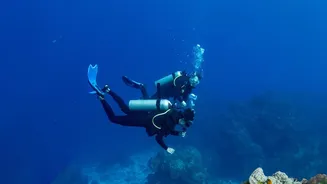
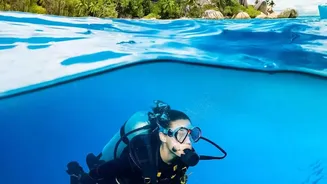
test to get certified. It demonstrates a fundamental level of comfort in an aquatic environment. However, the skills that make you proficient in a pool only scratch the surface of what’s needed when you descend into the ocean. Scuba diving isn't just advanced swimming; it's a completely different activity that relies on specialised equipment, an understanding of physics, and a new set of life-preserving rules. The biggest shift is mental: in swimming, your goal is to stay on the surface to breathe, while in diving, you are learning to exist entirely within a three-dimensional underwater space, independent of the surface.
The Golden Rule: Never Hold Your Breath
The most critical lesson in scuba diving is a direct contradiction of a swimmer's instinct: you must breathe continuously and never hold your breath. Swimmers train to hold their breath to be more efficient. Underwater, this is extremely dangerous. Divers breathe air that is compressed to match the surrounding water pressure. If you ascend even a few feet while holding your breath, the air in your lungs will expand as the water pressure decreases. This can lead to a serious, potentially fatal injury called a lung overexpansion injury, or pulmonary barotrauma. Training drills this rule into every new diver, teaching them to breathe slowly and calmly from their regulator, a skill that feels unnatural to someone used to surface swimming and breath-holding techniques.
Mastering Buoyancy: The Art of Weightlessness
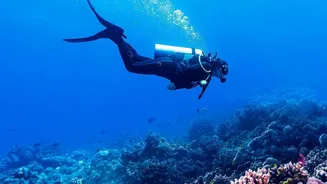
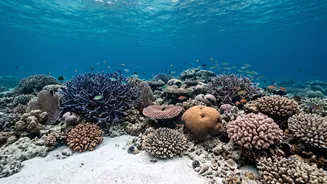
In a pool, buoyancy is simple: you either float or you sink. In scuba diving, the goal is to achieve neutral buoyancy, a state of perfect balance where you neither float nor sink, allowing you to hover effortlessly in the water. This is the single most important practical skill for a diver. It’s achieved by making tiny adjustments to the air in your Buoyancy Control Device (BCD)—a vest that can be inflated or deflated—and by using your own lung volume. Mastering this protects fragile marine ecosystems like coral reefs from accidental damage, conserves your energy, and dramatically improves air consumption, allowing for longer, safer dives. This fine control is something you never practice in a swimming pool and is a core focus of all beginner scuba courses.
Pressure, Gas and Your Body
The open water is an environment of immense and changing pressure. For every 10 metres you descend, the pressure increases by one atmosphere. Scuba training teaches you how to manage the physiological effects of this. You learn to 'equalise' the pressure in your ears and sinuses to prevent pain and injury, known as barotrauma. You also learn about how pressure affects the gases you breathe. Under pressure, nitrogen from your compressed air dissolves into your body's tissues. If you ascend too quickly, this nitrogen can form bubbles, leading to a painful and dangerous condition called decompression sickness, or 'the bends'. At greater depths, the buildup of nitrogen can also cause a state of confusion similar to intoxication, known as nitrogen narcosis. Certified training gives you the knowledge to manage your depth, bottom time, and ascent rate to avoid these serious risks.
Relying on Life-Support Equipment
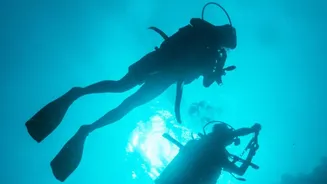
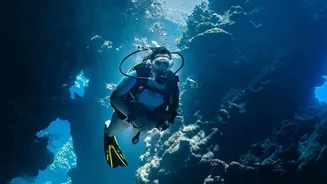
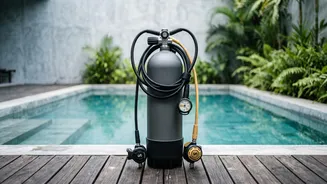
Unlike swimming, scuba diving means you are completely reliant on your equipment for survival. Your certification course spends significant time teaching you how to assemble, use, and troubleshoot your gear. You'll become familiar with the regulator that delivers your air, the BCD that controls your buoyancy, the submersible pressure gauge that tells you how much air is left, and the dive computer that tracks your depth and time. A crucial part of training involves practicing emergency procedures, such as how to handle a regulator failure or how to share air with a buddy who has run out. This equipment knowledge and the confidence to handle a malfunction are things a swimmer would never encounter but are essential for any diver.