






The Billion-Dollar Blind Spot
The James Webb Space Telescope (JWST) operates at a special spot 1.5 million kilometres from Earth known as Lagrange Point 2, or L2. This location is perfect for observing the universe, keeping the telescope cool and stable. However, it's far beyond the reach
of any crewed mission. Unlike its predecessor, the Hubble Space Telescope, which was serviced five times by astronauts in low-Earth orbit, Webb cannot be repaired or upgraded. If a critical component fails or a new technology emerges, there is no way to intervene. It was designed with no grapple points, no modular components, and no way for a spacecraft to safely approach without damaging its delicate sunshield. This makes the multi-billion-dollar observatory a disposable asset—spectacular, but with a finite, unchangeable lifespan.
A New Philosophy for the Cosmos
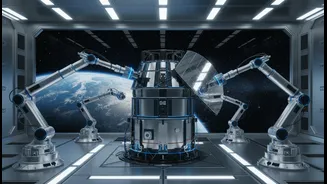
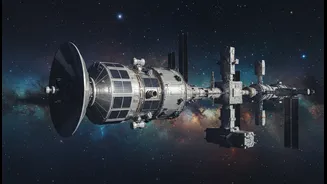
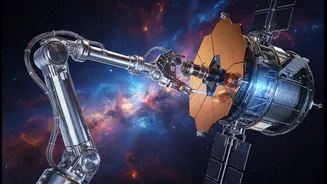
Learning from both Hubble's longevity and Webb's limitations, NASA is embedding a new philosophy into its next flagship mission: the Habitable Worlds Observatory (HWO). Planned for the 2040s, HWO will also operate at the distant L2 point, but with one crucial difference: it will be serviceable from day one. NASA has mandated that the observatory must be designed for robotic servicing, assembly, and maintenance. This strategic shift transforms the telescope from a static instrument into a dynamic, upgradable platform. The plan is to build the HWO with modular components, standardized interfaces, and accessible hardware, allowing robotic spacecraft to perform complex tasks that were once the domain of human astronauts. It’s a fundamental change in how we build our most ambitious eyes on the universe.
Enter the Robotic Mechanics
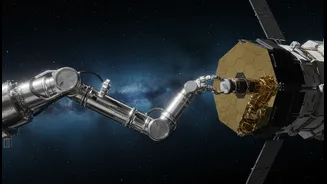
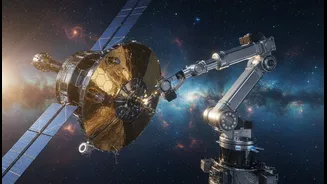
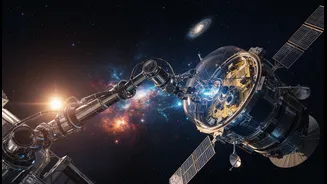
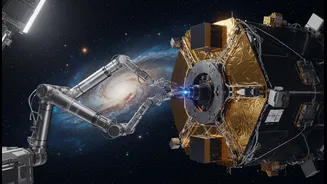
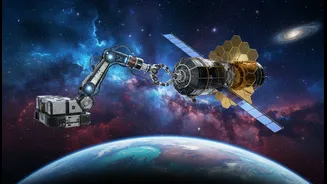
So, what can these robotic mechanics actually do? The possibilities are game-changing. Autonomous or remote-controlled spacecraft could be sent to rendezvous with HWO to refuel it, extending its operational life for decades. They could perform critical repairs, such as patching damage from micrometeoroid impacts—an issue that has already affected Webb to a greater degree than anticipated. Perhaps most excitingly, robots could swap out old scientific instruments for new, more powerful ones as technology advances. This is what kept Hubble scientifically relevant for over 30 years. The technology to do this is already being proven. While NASA's dedicated OSAM-1 servicing project faced challenges, commercial companies are already launching missions to service satellites in orbit, demonstrating that robotic assistance is no longer science fiction.
Beyond Repair: Building in Space
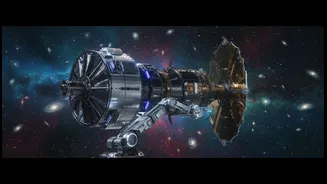
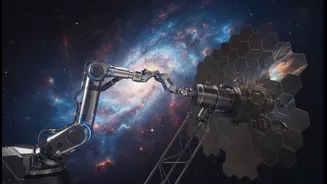
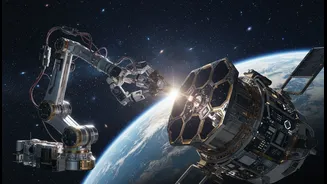
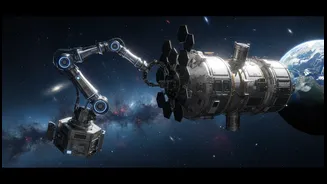
The vision for robotic servicing extends even beyond maintenance. One of the biggest constraints in telescope design is the size of the rocket fairing it must launch in. Webb’s massive 6.5-meter mirror had to be ingeniously folded to fit. For future observatories like HWO, which may require even larger mirrors to find signs of life on Earth-like planets, robotic assembly offers a solution. Segments of the telescope could be launched separately and then assembled in space by robotic arms. This opens the door to building observatories of a scale previously unimaginable, all without the risk and expense of sending human construction crews a million miles from home. It signals the start of a new era where we don't just launch telescopes; we build and maintain them in deep space.