








What is the Habitable Worlds Observatory?
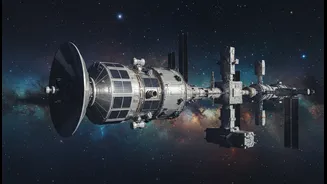
Set to launch in the 2040s, the Habitable Worlds Observatory is a multi-billion dollar space telescope with a primary mission that sounds like science fiction: to directly image rocky, Earth-sized planets around other stars and scan their atmospheres
for signs of life. This includes searching for chemical biosignatures like oxygen, methane, and water vapour. To achieve this, the HWO will operate in the ultraviolet, optical, and infrared spectrums, building on the legacies of the Hubble and James Webb space telescopes. Its goal is to identify and characterize at least 25 potentially habitable worlds, a quest that requires incredible technological precision. The telescope will be positioned 1.5 million kilometers from Earth at a location known as Lagrange Point 2 (L2), an ideal vantage point for deep space observation.
A Lesson from Hubble
The idea of servicing a space telescope isn't new. The Hubble Space Telescope, launched into a low-Earth orbit, was famously repaired and upgraded five times by astronauts on Space Shuttle missions. These missions were critical, fixing a flawed mirror shortly after launch and later installing more advanced instruments. This modular design, where astronauts could swap out components, dramatically extended Hubble's life and scientific value, keeping it at the forefront of astronomy for decades. However, the HWO's distant location at L2 makes human servicing missions logistically unfeasible with current technology. This presents a new challenge: how to maintain and upgrade a telescope that is simply too far away for astronauts to visit.
Enter the Robots
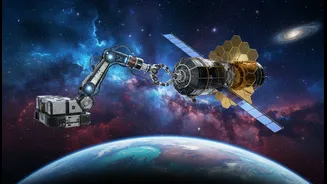
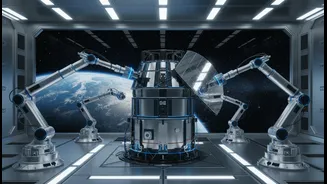
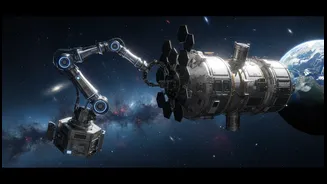
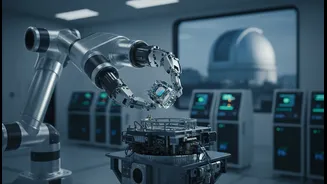
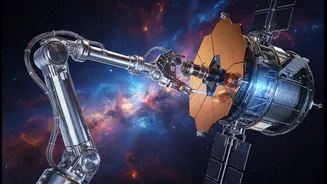
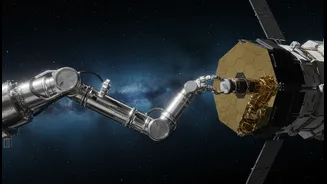
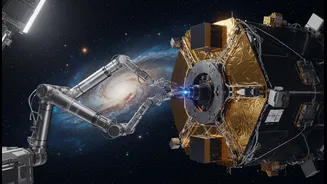
This is where robotic servicing comes in. NASA has confirmed that the HWO is being designed from the ground up with a crucial requirement: it must be serviceable by robots. This represents a fundamental shift away from the design philosophy of the James Webb Space Telescope, which was not designed with servicing in mind. For the HWO, NASA envisions autonomous or remotely operated spacecraft capable of traveling to L2, latching onto the observatory, and performing complex tasks. The design will feature standardized, line-replaceable units (LRUs), essentially modular components like computers and sensor arrays that a robot can easily unlock, slide out, and replace.
A More Flexible and Sustainable Future
This robotic-first approach makes the HWO an incredibly flexible tool. Instead of being locked into the technology it launches with, the observatory can be upgraded over its multi-decade lifespan. As scientists develop more sensitive instruments on Earth, a robotic servicer could deliver and install them, keeping the HWO scientifically relevant for longer. This flexibility also provides an insurance policy. If a critical component fails or a mirror is damaged, a robot could be sent to perform repairs. It even opens the possibility of assembling parts of the telescope in space if the final design is too large to fit into a single rocket fairing. This makes the estimated $11 billion investment in HWO more sustainable, maximizing its scientific return by treating it as an upgradable platform rather than a disposable one.
Challenges and a New Commercial Frontier
While the vision is compelling, the technology is still in development. Creating robots dexterous enough to perform delicate repairs on a complex observatory a million miles away is a significant engineering challenge. These robotic mechanics will need advanced autonomous capabilities to operate successfully. However, NASA's mandate is expected to be a major driver for the commercial in-space servicing, assembly, and manufacturing (ISAM) industry. Companies are already being contracted to study the architecture and logistics of these future missions. By planning for this capability decades ahead of the HWO's launch, NASA is not only shaping the future of astronomy but also helping to create a new commercial ecosystem in space.