



A Galactic Mystery
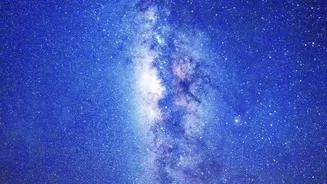
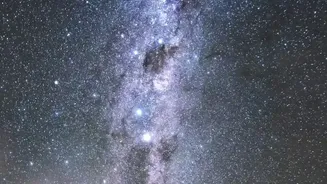
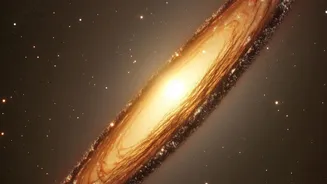
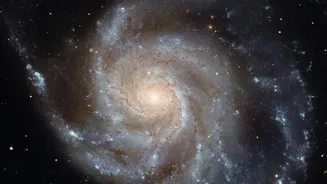
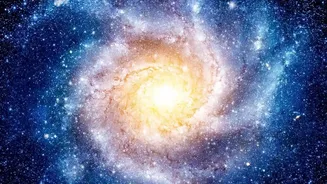
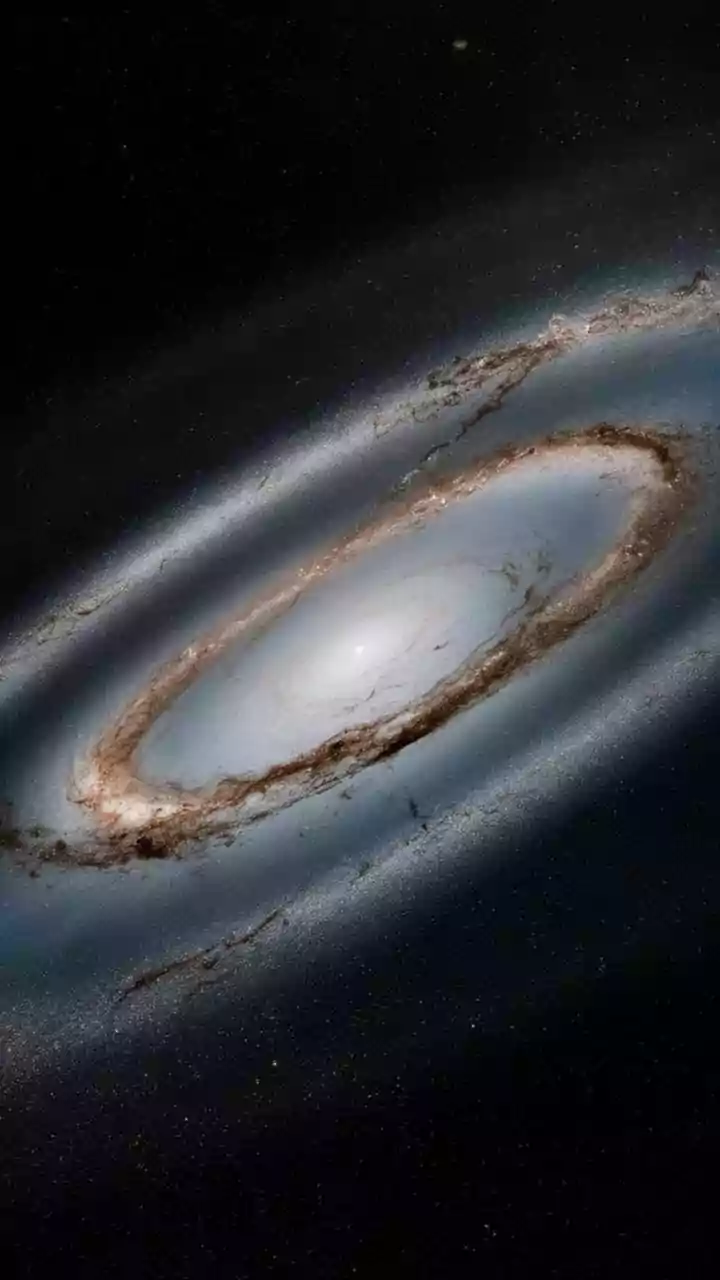
Imagine the Milky Way as a flat, spinning record. Most of its stars, including our Sun, are in this disc. Surrounding this is a vast, sparse sphere of older stars called the stellar halo. For years, astronomers have been puzzled by this halo. While the disc spins
rapidly, observations from missions like the European Space Agency's Gaia satellite have shown the halo barely rotates at all. This strange stillness has been a major cosmic question mark. Why would the outer reaches of our galaxy be so lethargic compared to the bustling disc within? The answer, it turns out, might not be about the halo itself, but about a cataclysmic event that happened to the disc billions of years ago.
The Cosmic Collision Hypothesis
Scientists already know that the Milky Way has not lived a quiet life. Around 10 to 11 billion years ago, it was involved in a massive, head-on collision with a large dwarf galaxy. This now-devoured galaxy, nicknamed the Gaia-Sausage-Enceladus, was the biggest merger in our galaxy's early history. It dumped billions of stars into the Milky Way, many of which now populate that mysterious, slow-spinning stellar halo. This merger was so transformative that researchers at Durham University wondered if it could be linked to the halo's strange behaviour. They hypothesised that such a violent collision could have done more than just add new stars—it might have knocked the entire Milky Way disc off its axis, causing it to gradually tip over.
Simulating a Violent Past
To test this dramatic idea, a team led by astronomer Kirill Batrakov couldn't rewind time. Instead, they did the next best thing: they used supercomputers. The researchers analysed 25 different cosmological simulations from a project known as the Auriga suite. Each simulation modelled the evolution of a galaxy similar to our own over billions of years, complete with galactic mergers and the complex dance of stars, gas, and dark matter. They sifted through these digital universes, looking for galaxies that ended up with a slow-rotating stellar halo, just like the real Milky Way. The results were striking and consistent. The simulated galaxies that matched our own shared two key events in their past: a massive, head-on collision and a dramatic 'disc flip', where the main disc of the galaxy tilted by more than 90 degrees.
What a Galactic Flip Means
The connection was clear: a major merger appears to lead to a disc flip, which in turn results in a slow-moving stellar halo. Since we have strong evidence the Milky Way experienced such a merger, the study concludes our galaxy's disc likely flipped as well. This wasn't a sudden, violent event, but a gradual reorientation that unfolded over billions of years. The implications are profound. It means that the stable plane our solar system travels on today is not where it has always been. Billions of years ago, our Sun and all its neighbours could have been moving on entirely different paths through the cosmos. This new understanding adds a dramatic chapter to our galaxy's biography, revealing a past defined by cosmic upheaval and reorientation.
Rewriting Our Cosmic Story
This discovery does more than just solve the riddle of the slow-moving halo. It gives astronomers a new tool to reconstruct the history of galaxy formation. By observing the present-day state of a galaxy's halo, they can now infer whether it likely experienced a major flip in its past. This connection also offers clues about the invisible dark matter halo that is believed to envelop our galaxy, as its structure and motion are thought to be linked to the stellar halo. Our galaxy is the closest and best-resourced laboratory we have for understanding how all galaxies evolve. Finding that it may have performed this cosmic somersault forces us to rethink its entire life story and its place in the universe.