





A Ghostly Void at the Galactic Centre
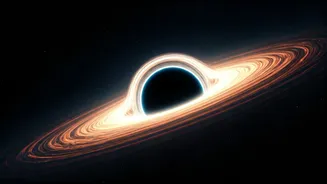
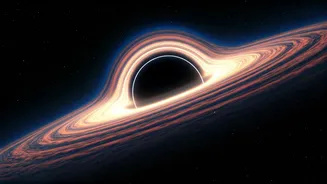
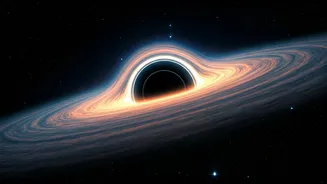
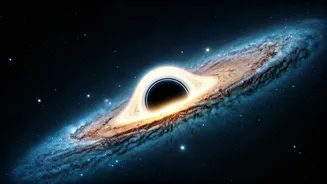
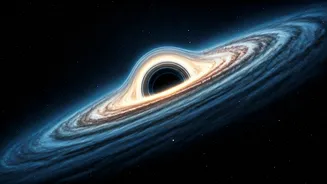
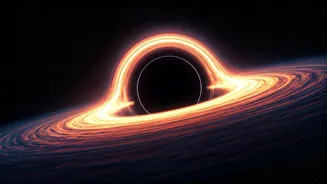
At the heart of our Milky Way galaxy, 26,000 light-years away, lies a supermassive black hole called Sagittarius A (Sgr A). This region is a chaotic swirl of stars, dust, and gas. Yet, using the Atacama Large Millimeter/submillimeter Array (ALMA) in Chile,
astronomers have found something startling: a huge, cone-shaped cavity completely empty of cold molecular gas. This void, stretching about three light-years in length, points directly at the black hole, looking like a giant scar in the fabric of the galaxy. For years, scientists theorised that black holes don't just consume matter but also expel energy, but finding definitive proof for our own galaxy's relatively quiet black hole has been elusive until now.
The Culprit: A 'Breathing' Black Hole
So what could carve out such a massive structure? The energy required to create this cavity is far more than nearby stars could produce. The evidence points squarely at Sagittarius A. The process is known as 'black hole feedback'. As gas and dust spiral into a black hole's accretion disk, the intense energy and pressure can launch powerful winds or jets of material back out into space at near light-speed. These outflows act like a cosmic sandblaster, pushing away or heating up the surrounding cold gas. This discovery provides the first clean view of this 'wind' from Sgr A, confirming it behaves like other, more active black holes in distant galaxies, just on a gentler scale.
How They Saw the Invisible
Detecting this cavity was a monumental feat of astronomical detective work. The team of astrophysicists from Northwestern University compiled over five years' worth of highly detailed observations from the ALMA telescope array. ALMA is uniquely suited to observe the faint glow of cold gas, specifically carbon monoxide molecules. However, the bright radio glow from the black hole itself had to be carefully modelled and digitally removed from the data. Once this digital 'fog' was lifted, the sharp outline of the gas-free cone emerged, leaving the researchers 'gobsmacked'. To be certain, they cross-referenced their findings with X-ray data from NASA's Chandra Observatory, which showed that the void was filled with hot, X-ray-emitting gas, a perfect fit for the black hole wind theory.
Solving a Galactic Puzzle
This discovery is more than just a cosmic curiosity; it's a crucial piece of the puzzle of how galaxies evolve. Supermassive black holes are not just passive residents but active regulators of their galactic environments. The fuel for new stars is cold gas. By creating these powerful outflows that clear out vast reserves of this gas, a supermassive black hole can effectively hit the brakes on star formation in its galaxy's central region. This 'feedback loop' helps explain why older, massive galaxies often have fewer new stars forming in their cores. Understanding this process in our own backyard gives scientists a vital model for how this cosmic balancing act plays out across the universe.