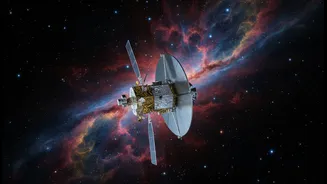

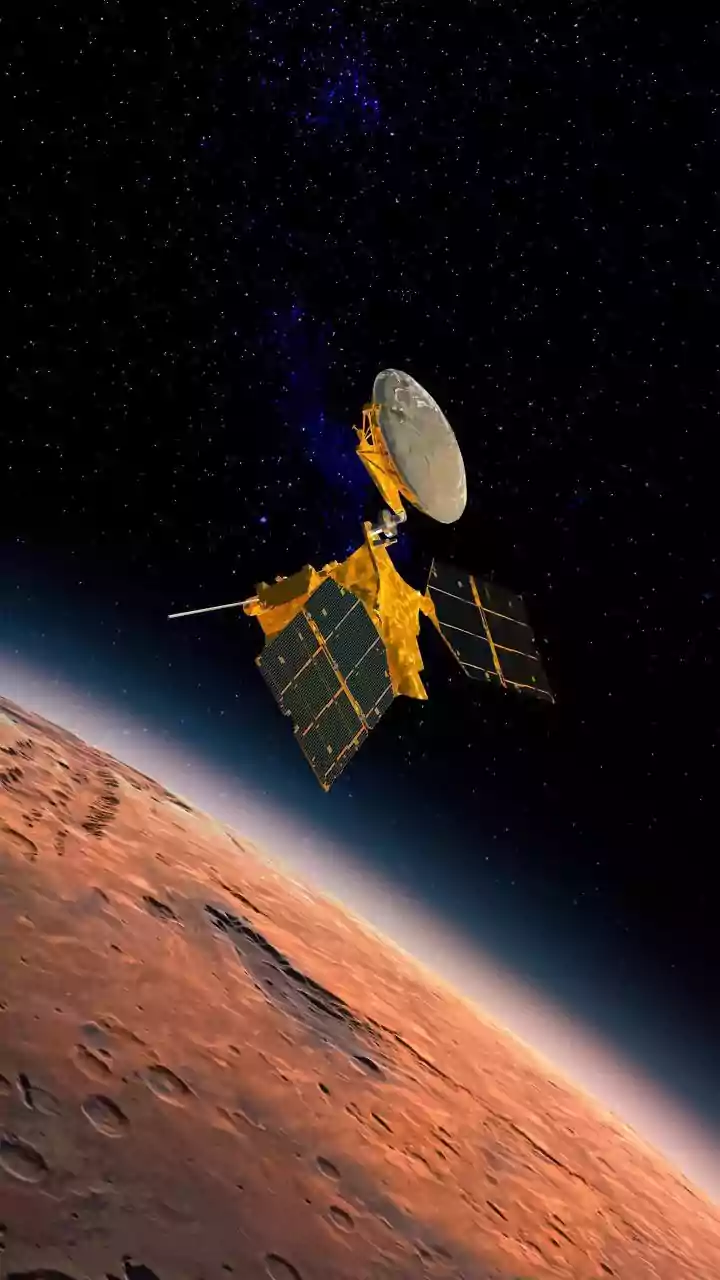




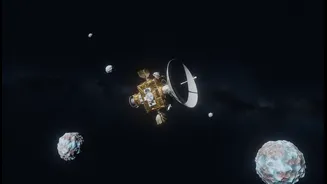
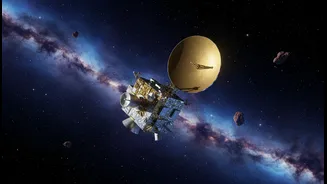
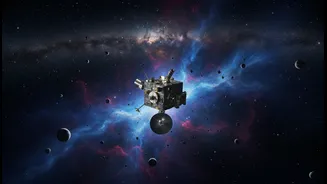


An Explorer Awakens
In late June 2026, after a 321-day hibernation to conserve resources, New Horizons woke itself up on schedule. Mission controllers at the Johns Hopkins Applied Physics Laboratory confirmed the probe was in perfect health, a remarkable feat for a machine
that has endured two decades in the harsh environment of space. This awakening wasn't just a system check; it marked the beginning of the next phase of its extended mission. The spacecraft began transmitting data its instruments had been passively collecting for nearly a year while most of its other systems were powered down. This information provides a unique, ongoing record of conditions in a region of our solar system no other active mission is currently exploring.
Beyond the Main Event
Many remember New Horizons for its spectacular flyby of Pluto in July 2015. For the first time, humanity saw the dwarf planet not as a fuzzy dot, but as a complex world with towering ice mountains, vast nitrogen glaciers, and a surprisingly layered atmosphere. The data completely rewrote our understanding of Pluto, revealing it to be geologically active and possibly harboring a subsurface liquid water ocean. As an encore, on New Year's Day 2019, the probe flew past Arrokoth, a billion miles beyond Pluto. This snowman-shaped object was the most distant and primitive solar system body ever explored up close, offering a pristine glimpse into the building blocks of planets from 4.5 billion years ago.
The New Mission: A Deep Space Observatory
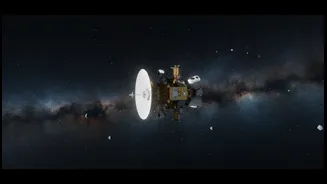
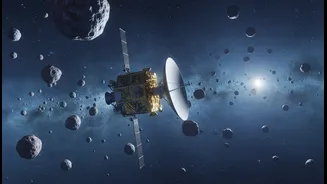
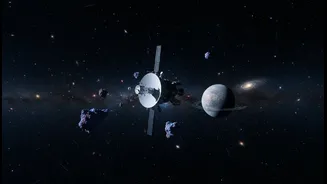
With no more flyby targets currently in its path, the mission has pivoted. New Horizons now serves as a one-of-a-kind observatory in the Kuiper Belt, the vast, donut-shaped ring of icy bodies beyond Neptune. Its current focus is on heliophysics: studying the Sun's outer environment. One of its key tasks is to measure the solar wind, the stream of charged particles flowing from the Sun. By tracking how this wind slows as it collides with interstellar particles, scientists can better map the boundary of our solar system, a region known as the heliosphere. The probe's instruments are providing the first data of its kind from this remote vantage point, complementing measurements made by the much older Voyager probes.
Listening to the Cosmos
The spacecraft’s work isn't limited to our Sun. Its instruments continue to scan the darkness, gathering data on the dust environment of the Kuiper Belt and observing other distant objects from a unique angle. Recently, its Alice ultraviolet spectrograph was tasked with observing the distribution of hydrogen gas at the edge of the solar system, where the Sun's influence wanes. This research helps scientists understand the so-called "hydrogen wall," a boundary first detected by the Voyager probes in the 1990s. With more advanced instruments, New Horizons can perform more sensitive measurements than its predecessors, providing a clearer picture of this mysterious frontier. These observations are crucial for planning future interstellar travel.
The Long Journey's End
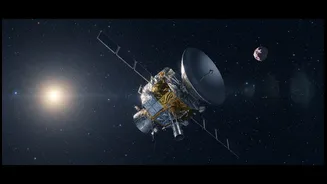
New Horizons is powered by a radioisotope thermoelectric generator (RTG), which uses the heat from decaying plutonium to generate electricity. This power source is finite. While the spacecraft has enough fuel and power to remain operational into the 2040s, its output diminishes each year. Eventually, likely in the late 2030s, it will no longer have enough power to run its systems and communicate with Earth. Until then, NASA plans to operate the mission until it exits the Kuiper Belt around 2028 or 2029. Should a new, reachable target be discovered, the probe is ready for one last potential flyby. When its mission finally ends, New Horizons will fall silent, continuing its journey as a silent emissary from Earth, coasting outward into the vastness of interstellar space.