

The Danger of Direct Sunlight
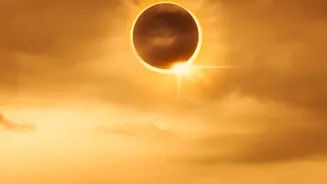
Before we get to the how, it's crucial to understand the why. Pointing an unfiltered camera lens at the sun, even during a partial eclipse, is like using a magnifying glass to focus intense light and heat onto one spot. This can melt or crack lens elements,
destroy the delicate blades of your lens's aperture mechanism, and permanently fry your camera's sensor, leading to dead pixels or complete failure. The risk is not theoretical; rental companies reported numerous cameras being destroyed by users during the 2017 solar eclipse. Standard neutral density (ND) filters are not sufficient, as they may block visible light but not the intense infrared and UV radiation that cause damage.
Method 1: The Pinhole Projector
The simplest and most accessible way to view and photograph an eclipse indirectly is with a pinhole projector. This method uses a small box and basic household items to project a live image of the sun onto a surface. To make one, take a long cardboard box and cut a small hole in one end. Cover this hole with a piece of aluminum foil and poke a tiny, clean hole in the foil with a pin. On the opposite inside wall of the box, tape a sheet of white paper to act as a screen. To use it, stand with your back to the sun and aim the pinhole end toward it. An inverted image of the sun will appear on the white screen inside. You can then photograph this projected image on the screen, completely avoiding any risk to your camera.
Method 2: Projection with Binoculars
For a larger and sharper projected image, you can use binoculars or a small telescope. First, securely mount the binoculars on a tripod. It is critical to cover one of the main lenses completely with its lens cap. Never look through the binoculars or their viewfinder while they are pointed at the sun. With your back to the sun, aim the uncovered lens in its direction until a bright circle of light is projected from the eyepiece. Place a white card or piece of paper a foot or two behind the eyepiece to serve as your projection screen. You can adjust the focus knob on the binoculars to make the projected image of the sun's crescent sharp and clear. This method creates a much more detailed image to photograph, but be careful not to leave the binoculars aimed at the sun for extended periods, as the concentrated heat can damage their internal components.
Photographing the Projection
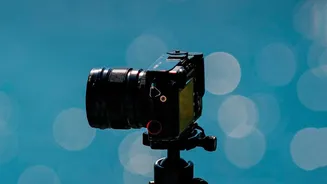
Once you have a stable and clear projected image, photographing it is straightforward. Use a tripod to keep your camera steady. If you're shooting a projection in a dark box, you may need to use a slightly longer shutter speed. If you are projecting onto a card in the open, shield the 'screen' from as much ambient light as possible to increase the contrast of the sun's image. Focus your camera on the projected image, not the projector itself. Use your camera's settings to properly expose for the bright image of the sun on the card. Taking a few test shots will help you dial in the ideal settings.
What About Solar Filters?
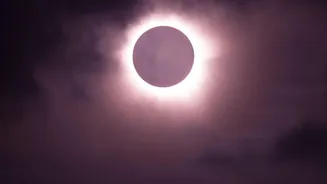
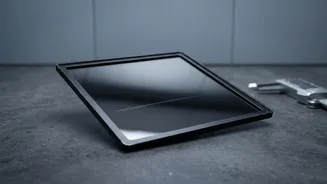
While this guide focuses on indirect methods, the other safe way to photograph an eclipse is by using a special-purpose solar filter. These filters, which often reduce light by 16 stops or more, are designed to block harmful radiation and must be securely mounted to the front of your lens. This protects the entire optical system. If you're in the path of a total solar eclipse, these filters are necessary for all partial phases. However, they must be removed during the brief moments of totality to capture the faint corona. Then, as soon as the sun begins to reappear, the filter must be put back on immediately.
Don't Forget Your Own Eyes
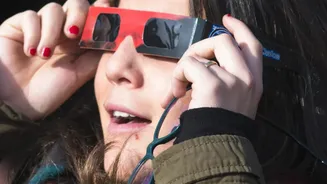
Finally, remember that protecting your camera is secondary to protecting your vision. Never look directly at a partial solar eclipse without certified eclipse glasses or a solar viewer that meets the ISO 12312-2 international standard. Looking at the sun through an unfiltered camera viewfinder, binoculars, or telescope can cause instant and permanent eye damage. Even if your camera is using a projection method, you still need proper eye protection to look up at the sun itself.