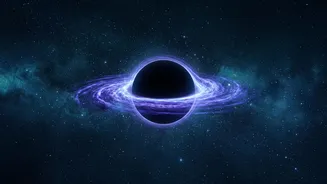




The universe is full of massive objects, but none capture the imagination quite like black holes. We know about supermassive ones, but scientists are now pondering a new class of monster: the 'stupendously large black hole'. But do they exist?
From Supermassive to Stupendously Large
Astronomers
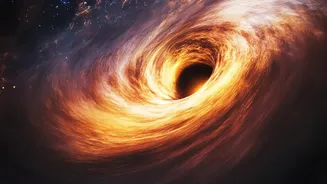
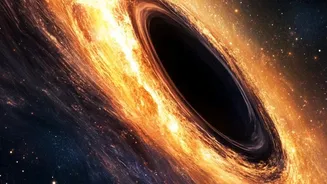
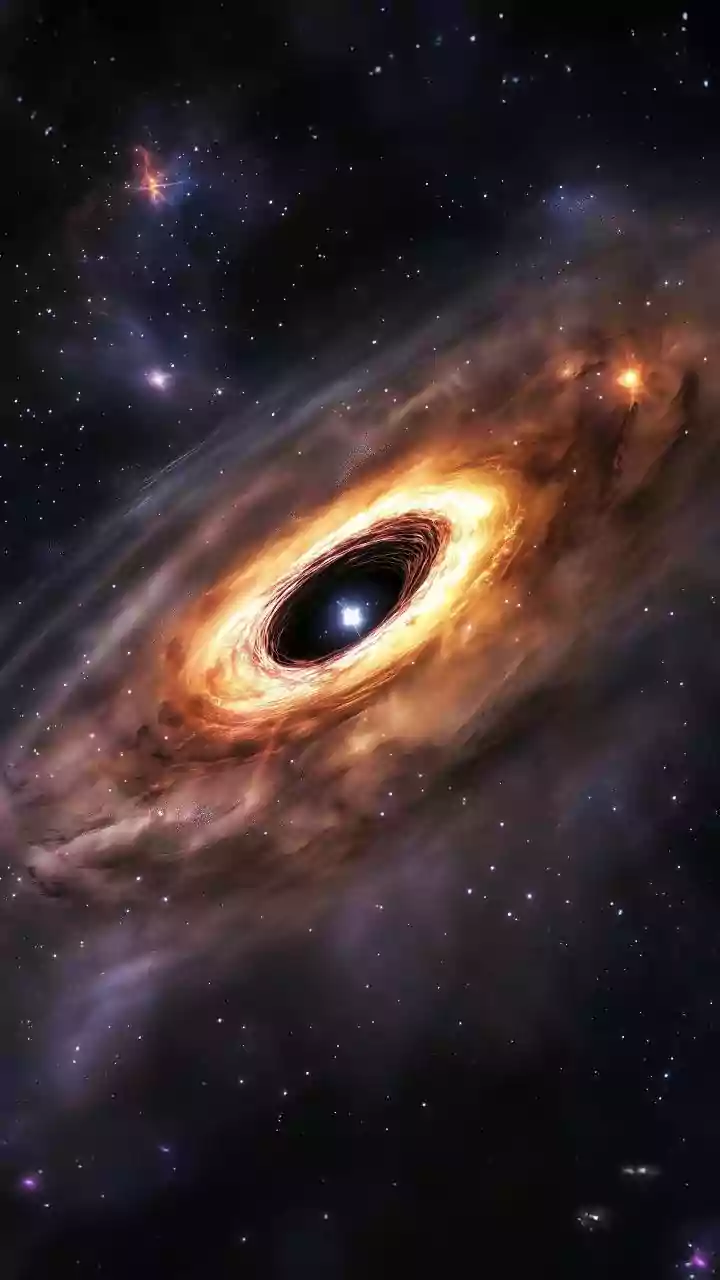
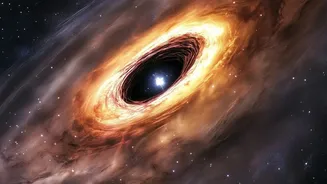
are well-acquainted with supermassive black holes (SMBHs). These cosmic titans, with masses millions or even billions of times that of our Sun, are found at the heart of most large galaxies, including our own Milky Way. The largest confirmed black hole weighs in at around 36 to 66 billion solar masses. But some theorists are asking: is that the limit? Enter the concept of 'Stupendously Large Black Holes', or SLABs. These are hypothetical objects with masses starting at 100 billion times that of the sun, and potentially reaching into the trillions. A SLAB could be heavier than an entire galaxy. Unlike SMBHs, which are thought to grow by consuming stars and gas or merging with other black holes within a galaxy, SLABs might have a far more ancient and exotic origin story.
Are They Relics of the Big Bang?
The leading theory is that SLABs could be 'primordial'. This means they would have formed not from the collapse of a giant star, but from immense density fluctuations in the hot, chaotic soup of the very early universe, long before stars and galaxies even existed. This primordial origin allows for a much wider range of possible masses, from the tiny to the truly stupendous. The idea, championed by physicists like the late Stephen Hawking, suggests these primordial black holes could be a candidate for one of the biggest mysteries in cosmology: dark matter. Dark matter is an unseen substance that makes up about 85% of the matter in the universe, and its gravity is what keeps galaxies from spinning apart. While SLABs themselves are too large and would be too sparse to account for all dark matter, their existence would lend major support to the theory that smaller, more numerous primordial black holes could be the answer.
The Search for Cosmic Ghosts
Finding a SLAB is an immense challenge. You can't see them directly, as their gravitational pull is so strong that not even light can escape. Scientists must look for their effects on their surroundings. One method is to search for gravitational lensing, where a massive object bends the light from a distant galaxy or quasar behind it, creating distorted or multiple images. The lack of such observed distortions places firm limits on how many SLABs could be out there. Another ingenious method involves looking for their 'shadows'. A recent research proposal suggests that a SLAB would be so large it would cast a detectable cold spot, or shadow, against the faint glow of the Cosmic Microwave Background (CMB) — the leftover radiation from the Big Bang. The pattern of the CMB tells us how matter was distributed in the early universe, and if it were 'grainy' with giant black holes, that pattern would look different. Recent analysis of the CMB has shown it is not grainy in the way SLABs would make it, ruling them out as a major component of dark matter.
Why the Search Matters
The latest research, including a study set for publication on October 26th, reinforces the idea that stupendously large black holes do not constitute a significant portion of the universe's dark matter. By analysing the smoothness of the Cosmic Microwave Background, scientists have effectively put a cap on how many of these behemoths could be hiding in the cosmic dark. However, this doesn't mean they can't exist at all. It simply means they are not the widespread solution to the dark matter problem. The quest for SLABs is far from over. Their discovery would be revolutionary, confirming the existence of primordial black holes and opening a new window into the universe's first moments. Conversely, proving they don't exist is also valuable, as it allows scientists to rule out theories and focus on other possibilities for what dark matter might be, such as smaller primordial black holes or undiscovered elementary particles.