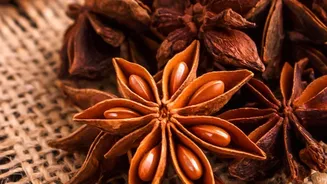







It’s one of the most visually striking spices in any kitchen, and its name is as straightforward as it gets. But the story of star anise, the dried, star-shaped fruit of the Illicium verum tree, goes far beyond its appearance.
A Name Written in the Stars
The name 'star anise' is a literal
description of the spice's form. Harvested from a medium-sized evergreen tree native to Southern China and Vietnam, the fruit is picked before it ripens and then dried in the sun. This process hardens the fruit into a reddish-brown, woody pod with typically six to eight points arranged in a distinctive star shape. Each of these points, or carpels, holds a single glossy seed. While both the pod and seed are used, the pod contains most of the aromatic essential oils. Its scientific name, Illicium verum, even hints at its allure, with 'illicium' deriving from a Latin word meaning 'entice'.
A Journey Through Cuisines
For over 3,000 years, star anise has been a staple in Asian medicine and cooking. It was introduced to Europe in the late 16th or early 17th century, quickly becoming a prized commodity traded along tea routes through Russia and Persia. In Indian cuisine, it's known as 'chakra phool' and is a key component in warming spice blends like garam masala and the fragrant base of dishes like biryani and pulao. Its flavour is essential to Chinese five-spice powder and the rich broth of Vietnamese pho. The spice's characteristic flavour comes from a compound called anethole, which gives it a potent, licorice-like taste that is much stronger and spicier than that of aniseed, a botanically unrelated plant.
The Unexpected Link to Modern Medicine
Beyond its culinary uses, star anise has a remarkable connection to modern pharmaceuticals. It is the primary natural source of shikimic acid, a compound that is a crucial starting material for synthesizing oseltamivir, the antiviral drug widely known by its brand name, Tamiflu. During global flu concerns in the mid-2000s, demand for the spice surged, causing prices to skyrocket as it became a strategically important botanical for pharmaceutical production. Up to 90% of the world's shikimic acid has been derived from the star anise crop. It is important to note, however, that simply consuming star anise in tea or food does not act as an antiviral or prevent the flu; the shikimic acid requires a complex pharmaceutical process to be converted into the active drug.
A Legacy in Traditional Wellness
Long before its role in modern medicine was understood, star anise was a cornerstone of traditional healing practices. In Chinese and folk medicine, it has been used for centuries, often steeped into a tea to aid with digestive issues like bloating and indigestion, or to address respiratory complaints. It's known for its carminative properties, meaning it can help relieve flatulence. Traditional uses also include soothing coughs and promoting respiratory health. These benefits are often attributed to its rich concentration of bioactive compounds, including antioxidants and essential oils like linalool and anethole.
Buyer Beware: The Toxic Lookalike
A crucial fact for anyone purchasing star anise is the existence of a dangerous doppelgänger: Japanese star anise (Illicium anisatum). While it looks strikingly similar to the edible Chinese variety, Japanese star anise is highly toxic and should never be consumed. It contains a potent neurotoxin called anisatin, which can cause severe illness, including seizures and inflammation of the kidneys and digestive organs. Cases of illness from star anise tea have sometimes been traced to accidental or deliberate adulteration with the toxic Japanese species. To tell them apart, look closely: edible Chinese star anise is generally larger and plumper, with eight robust, regularly shaped points, and has a strong, sweet licorice smell. The toxic Japanese variety is often smaller, more irregular with more numerous, hook-tipped points, and smells more medicinal or woody.