




The Moon's Navigation Challenge
For decades, navigating in space has been a complex process heavily reliant on Earth. Missions have depended on the Deep Space Network (DSN), a global system of large radio antennas, to track spacecraft and provide location data. This method, while effective,
has significant limitations. There are communication delays, and continuous tracking requires a direct line of sight between the asset, a relay orbiter, and Earth. For a future where rovers and astronauts are constantly on the move, this is slow and inefficient. It prevents true autonomy, forcing lunar explorers to move cautiously and remain tethered to mission control for positioning updates. Without a local navigation system, a rover getting lost or an astronaut needing to find their way back to a habitat in an emergency becomes a life-threatening problem.
LunaNet: An Internet for the Moon
NASA's answer to this challenge is LunaNet, an ambitious architecture designed to be a flexible and extensible communications and navigation network for the Moon. Think of it less like a single payload and more like creating an internet and GPS system for the Moon, all rolled into one. The goal is to create an environment where missions can operate with independence from Earth, enabling a new era of exploration and commercial activity. LunaNet is not just a NASA project; it's an open framework designed for international partners and commercial companies to contribute to, building a shared infrastructure for all lunar missions. This network will provide three core services: networking (like Wi-Fi), science utilization, and crucially, positioning, navigation, and timing (PNT) services.
Lunar Node-1: The First Beacon
A key step in building LunaNet was the Lunar Node-1 (LN-1) experiment, a technology demonstrator that flew to the Moon aboard a commercial lander in early 2024. Developed at NASA's Marshall Space Flight Center, LN-1 is a small radio beacon designed to provide a fixed reference point on the lunar surface. By broadcasting its signal, LN-1 allows other assets—like landers, orbiting spacecraft, or future rovers—to calculate their position relative to it, much like how your phone uses signals from multiple GPS satellites. The LN-1 mission successfully demonstrated its core navigation technologies, transmitting data to the Deep Space Network and proving that a compact, surface-based radio beacon could work as intended. It's the first step toward a constellation of similar beacons that will one day blanket the Moon in navigation signals.
Empowering Autonomous Rovers and Astronauts
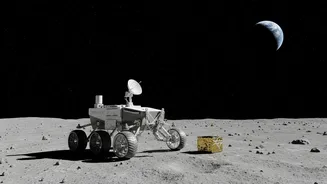
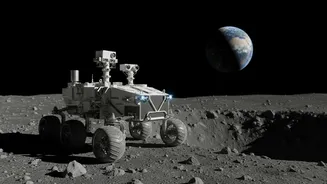
For future lunar rovers, this technology is a game-changer. Currently, rover navigation is a painstaking process, often involving visual odometry (tracking movement by analyzing images) and careful teleoperation from Earth. With a reliable PNT service from LunaNet, rovers can navigate autonomously and with confidence. This means they can travel farther, cover more ground, and conduct more complex scientific investigations without constant human supervision. Reliable navigation is critical for tasks like resource prospecting, where a rover might need to travel hundreds of kilometers. For astronauts, it provides a crucial safety net, allowing them to know their precise location during extra-vehicular activities (EVAs) and ensuring they can always find their way back, even if the rover they are using breaks down far from the base.
Beyond Beacons: A Multi-Layered Approach
LunaNet’s navigation capabilities won't just come from surface beacons. NASA is pursuing a multi-pronged strategy. This includes using signals from Earth's own GPS satellites, which have been proven to be usable even at lunar distances. Payloads like the NavCube3-mini are being developed to capture these faint signals and provide an additional layer of positioning data. Furthermore, NASA is developing advanced laser-based systems, known as Navigation Doppler Lidar (NDL), to provide hyper-accurate velocity and altitude data during the critical landing phase. This combination of surface beacons, orbital relays, Earth-based signals, and advanced sensors will create a resilient, multi-layered navigation grid, ensuring that no matter where you are on or around the Moon, you'll never be lost.