

The World Beneath the Waves
Imagine a place of eternal darkness, near-freezing temperatures, and pressure so immense it would crush most life forms. This is the hadal zone, the parts of the ocean deeper than 6,000 meters, found almost exclusively in deep-sea trenches. The most famous
of these is the Mariana Trench, a crescent-shaped scar in the Earth's crust that plunges to nearly 11,000 meters at its deepest point. If you were to place Mount Everest inside, its peak would still be submerged by over two kilometers of water. For decades, these trenches were considered remote and lifeless voids. But thanks to advanced submersibles, we now know they are dynamic environments, home to uniquely adapted creatures and powerful geological forces that have planetary consequences.
The Planet's Great Water Pump
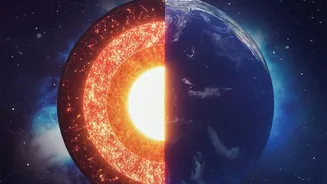
One of the most significant processes occurring in these trenches is subduction. This is where one massive tectonic plate slides beneath another, slowly descending into the Earth's mantle. The Pacific Ocean is almost entirely surrounded by such subduction zones, forming the infamous 'Ring of Fire'. As the vast Pacific Plate bends and plunges into trenches like the Mariana, it doesn't go down alone. Through cracks and faults in the seafloor, enormous quantities of seawater are drawn down, becoming trapped in the rock as hydrous minerals. Recent seismic studies have revealed that this process pulls three to four times more water into the deep Earth than previously estimated. This makes subduction zones a critical, and surprisingly large, component of the global water cycle, acting like a planetary-scale pump that has regulated sea levels for geologic eons.
A Conveyor Belt for Contaminants
While this geological water cycle is a natural process, it has a dark side in the modern era. The same forces that pull water into the mantle also make the trenches natural funnels for anything sinking from the surface. Unfortunately, that now includes our waste. Scientists have been shocked to find plastic debris, including single-use plastic bags, at the very bottom of the Mariana Trench. Studies show that in areas deeper than 6,000 meters, over half of all man-made debris is plastic. Once these plastics reach the deep sea, they can persist for thousands of years, far from sunlight that might help break them down. Furthermore, microplastics are being ingested by the unique creatures that live in these trenches, introducing pollution into a food web we are only just beginning to understand.
An Ecosystem Under New Threat
Beyond pollution, a new and potentially more destructive threat looms: deep-sea mining. The seafloor in and around the Pacific, particularly in areas like the Clarion-Clipperton Zone, is rich in potato-sized nodules containing valuable minerals like nickel and cobalt, essential for green technologies. Mining these deposits would involve gigantic machines scraping the ocean floor, destroying habitats that have taken millions of years to form. This would not only wipe out species, many of which are still unknown to science, but it could also create vast sediment plumes that could drift for miles, burying nearby ecosystems and disrupting marine life. The deep ocean is also a critical carbon sink, and scientists warn that mining could disrupt its ability to store carbon, with irreversible consequences for the climate.