







The Hip and Glute Problem
When you sit for hours on end, your body adapts to that position, and not for the better. Your hip flexors, the muscles at the front of your hips that lift your knee, become short and tight. This constant shortening can lead to a feeling of stiffness
and may limit your range of motion, making it harder to stand up straight or walk with a natural gait. While your hip flexors are tightening, another crucial muscle group is switching off: your glutes. The gluteal muscles, which are among the largest in your body, become inactive and weak from prolonged sitting. This combination of tight hip flexors and weak glutes creates an imbalance that pulls on your pelvis, often contributing to lower back pain and poor posture. Over time, this can lead to hip joint problems and a cycle of discomfort that affects everyday movements.
The Strain on Your Back and Spine
Your spine is designed for movement, not for being locked in a seated C-shape for eight hours a day. When you sit, especially if you slouch, you put immense pressure on the discs in your spine. These discs act as cushions between your vertebrae, and sustained pressure can cause them to compress, potentially leading to premature degeneration and chronic pain. Poor posture while sitting is a major culprit. Hunching forward rounds your back and causes your head to jut forward, putting a significant strain on the muscles and ligaments in your neck and upper back. This can result in persistent upper back pain, tension headaches, and what many call 'tech neck'. The muscles that are supposed to support your posture become fatigued and weak, making it even harder to sit up straight and perpetuating a painful cycle of slouching and stiffness.
Shoulders, Neck, and Beyond
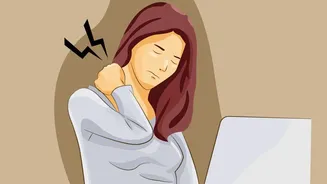
The stiffness doesn't stop at your back. As you lean toward a computer screen, your shoulders tend to round forward and internally rotate. This posture shortens and tightens the muscles in your chest while overstretching and weakening the muscles in your upper back. This imbalance contributes to that familiar aching, burning sensation between your shoulder blades and can lead to shoulder impingement issues over time. But the consequences of long, uninterrupted sitting are more than just muscular. This sedentary behaviour impacts your entire body system. Circulation slows down, which can cause blood to pool in your legs. Your body also becomes less efficient at processing fats and sugars, as your large, inactive muscles don't take up much glucose from the blood. This can contribute to metabolic issues and an increased risk of chronic conditions.
From Stiffness to Systemic Risk
This collection of issues is so common that experts have coined the term 'sitting disease' to describe the cluster of health risks associated with a sedentary lifestyle. These risks go far beyond simple aches and pains. Research has linked prolonged sitting to an increased risk of serious health problems, including heart disease, type 2 diabetes, high blood pressure, and even certain types of cancer. The most surprising finding from recent studies is that a single daily workout may not be enough to completely undo the damage caused by sitting for the rest of the day. While exercise is crucial, breaking the cycle of uninterrupted sitting appears to be just as important for maintaining long-term health. The problem isn't just a lack of exercise; it's the continuous, unbroken state of being seated that poses a unique threat to our well-being.