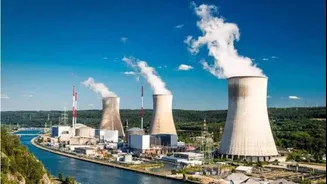




Amid renewed global interest in nuclear energy, the International Atomic Energy Agency (IAEA) has released its latest projections. But what do the numbers say, and what did IAEA chief Rafael Mariano Grossi actually predict for the atom's future?
Understanding the IAEA's Projections
The International
Atomic Energy Agency doesn't make a single, definitive prediction. Instead, it publishes annual projections with two main scenarios: a 'low case' and a 'high case'. The low case assumes current market trends and policies continue with few changes. The high case, however, considers stated national intentions and more favorable policies for nuclear power. For the sixth consecutive year, the IAEA has revised its projections upward. In its latest report, which extends to 2060, the high-case scenario projects that global nuclear capacity could reach 1,284 gigawatts (GW) by 2060. This would be approximately 3.4 times the capacity recorded at the end of 2025. The low-case scenario is also optimistic, projecting a near doubling of capacity to 696 GW in the same period.
What the IAEA Chief Actually Said
Recent headlines have focused on a statement by IAEA Director General Rafael Mariano Grossi, suggesting nuclear power could triple by 2060. This aligns with the agency's high-case projection. Grossi's remarks, delivered during the presentation of the IAEA's annual report to the UN General Assembly, highlight the factors driving this potential growth. He has pointed to a 'growing global consensus' that nuclear power is essential for clean and reliable energy. Rather than making a single firm prediction, Grossi frames the future of nuclear as something to be built, not just foreseen. His message is one of potential; the high-growth scenario is 'plausible and technically feasible,' but requires significant investment, supportive policies, and timely project delivery to become a reality.
The Drivers: AI, Energy Security, and Climate Goals
Several powerful trends are pushing nuclear energy back into the global spotlight. Director General Grossi has specifically identified the massive electricity demands of data centers powering artificial intelligence as a key driver. Technology companies are increasingly seeking reliable, 24/7 carbon-free power, a niche that nuclear energy is well-suited to fill. Beyond the tech sector, energy security has become a paramount concern for many nations, who see domestic nuclear power as a way to gain independence from volatile global energy markets. This is particularly true in Europe, where many countries are either expanding existing nuclear programs or embarking on new ones. Finally, the overarching goal of decarbonization remains a powerful incentive. Nuclear power currently provides about a quarter of the world's low-carbon electricity, and many experts believe climate goals are unreachable without it.
The Rise of Small Modular Reactors (SMRs)
A significant part of the projected growth hinges on a new generation of nuclear technology: Small Modular Reactors, or SMRs. These are advanced reactors with a smaller footprint, designed to be factory-built and assembled onsite, potentially reducing costs and construction times. The IAEA's latest projections show a substantial role for SMRs. In the high_growth scenario, SMRs could account for 28% of all new nuclear capacity added by 2060. This technology is seen as a more affordable and flexible option for developing countries and for powering smaller grids or remote industrial sites. Director General Grossi notes that for SMRs to be deployed successfully and on time, a harmonized regulatory and industrial approach will be necessary.
What This Means for India
The global trends identified by the IAEA resonate strongly with India's own energy ambitions. As a rapidly growing economy with soaring electricity demand, India has long pursued nuclear power as a clean and reliable energy source. The global push for energy security and decarbonization aligns with India's national strategy to expand its nuclear fleet. The IAEA report projects that the largest share of future nuclear growth will be in Central and Eastern Asia. While the report does not detail country_specific plans, the focus on this region underscores the momentum behind nuclear development in countries like India and China. The development of SMRs could also present a significant opportunity for India, potentially offering a more scalable path to increasing nuclear capacity and meeting the energy needs of its diverse regions.