







From Blazars to Microblazars
To understand a microblazar, we first need to look at its much larger cousin: the blazar. At the heart of some distant galaxies, supermassive black holes millions or billions of times heavier than our sun gorge on surrounding gas and dust. This process
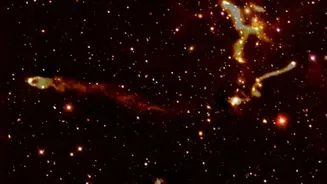
can launch enormous, powerful jets of ionised matter, called plasma, at near-light speed. When one of these jets happens to be aimed almost directly at Earth, the object is called a blazar. This alignment makes it appear incredibly bright due to an effect called relativistic beaming. A microblazar is essentially a scaled-down version of this phenomenon. Instead of a supermassive black hole, the engine is a stellar-mass black hole, just a few to perhaps a hundred times the sun's mass, in a binary system with a companion star. It produces similar jets, but on a much smaller scale. When one of those jets is pointed our way, we call it a microblazar.
Hiding in Plain Sight
The candidate object, IRAS 18293-0941, was first catalogued in 1983 but remained largely unstudied for decades. It is located in the constellation Scutum and is so heavily obscured by interstellar dust that it's practically invisible in ordinary optical images. This cosmic dust veil is what allowed it to go unnoticed for so long. The system consists of a black hole, estimated to be about 10 times the mass of our sun, and a massive companion star. The two orbit each other every 11 days. In this tight cosmic dance, the black hole's immense gravity strips material away from its companion star, pulling it into a swirling accretion disk before gobbling it up.
The Evidence for a Microblazar
What makes astronomers suspect this is a long-sought microblazar? Renewed interest came from radio surveys which revealed a bright core with an elongated structure extending from only one side. This one-sided appearance is a classic sign of relativistic beaming, where the jet pointed towards us appears intensely bright, while the one moving away is too faint to see. An international team of researchers confirmed that one jet is indeed aimed towards Earth, blasting plasma at roughly 75% of the speed of light. Meanwhile, the opposing jet is shooting in the other direction, slamming into a nearby molecular cloud and creating an observable 'hotspot'. While theorists predicted microblazars would be highly variable in brightness, this rapid flickering hasn't yet been seen in IRAS 18293-0941, possibly because the dense gas surrounding it smooths out the fluctuations.
A Natural Laboratory in Our Galaxy
The discovery of a strong microblazar candidate so close to home is a major breakthrough. For over 30 years, astronomers theorised that these objects should exist in the Milky Way, but finding one proved difficult. Full-fledged blazars are billions of light-years away, making their core mechanics impossible to study in detail. IRAS 18293-0941, however, offers a 'front-row seat' to the physics of relativistic jets. Because these smaller systems evolve on human timescales—days or weeks, rather than millions of years—they act as cosmic laboratories. They allow scientists to observe how black holes accelerate particles to incredible speeds and pour energy into their surroundings. This could help solve long-standing mysteries, such as the origin of some ultra-high-energy cosmic rays that bombard Earth.