


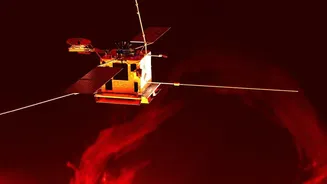
India’s Vigilant Eye on the Sun
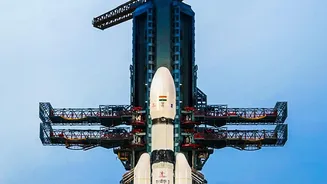
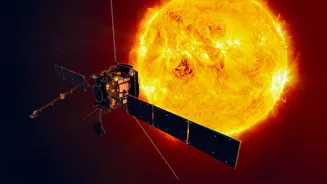
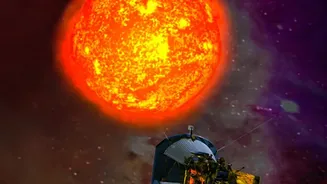
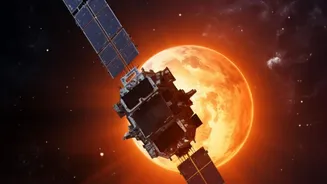
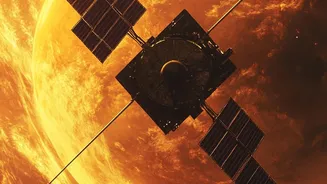
Launched in September 2023, Aditya-L1 is India’s first dedicated solar observatory, a testament to ISRO's growing prowess in space exploration. The spacecraft is strategically positioned at Lagrange point 1 (L1), a gravitationally stable spot 1.5 million
kilometres from Earth that offers an uninterrupted view of the Sun. Its suite of seven instruments is designed to study the Sun’s outer layers—the photosphere, chromosphere, and the corona—along with the solar wind. A key instrument, the Visible Emission Line Coronagraph (VELC), allows scientists to perform spectroscopy on the corona, analysing the temperature, velocity, and density of the superheated plasma. This provides crucial data on the 'what' and 'how' of solar phenomena.
Europe’s Ingenious Artificial Eclipse
The European Space Agency's Proba-3 mission, launched in December 2024 aboard an Indian PSLV rocket, is a marvel of engineering. It is the world's first precision formation-flying mission, consisting of two separate spacecraft. The 'Occulter' spacecraft flies about 150 metres ahead of the 'Coronagraph' spacecraft, precisely blocking the Sun's bright face. This creates a sustained, artificial solar eclipse in space, an effect that on Earth lasts only for minutes. This unique setup allows Proba-3’s main instrument, ASPIICS, to capture incredibly clear images of the Sun's faint, inner corona—a region normally blinded by the Sun's own glare. This gives scientists a front-row seat to see the 'where' of solar eruptions as they begin.
A Partnership Forged in Science
The true power of this collaboration lies in how these two missions complement each other. While Proba-3 provides crisp images of solar events like Coronal Mass Ejections (CMEs) taking shape very close to the Sun, Aditya-L1 provides the deeper context. VELC on Aditya-L1 uses spectroscopy to measure the physical properties of the erupting plasma, such as its temperature and density, while ASPIICS on Proba-3 tracks its shape, movement, and mass. For the first time, scientists have combined data from both missions to study the same CMEs, which occurred in September 2025. This dual perspective—one mission taking a high-resolution photo and the other running a detailed diagnostic scan—creates a far more complete picture of solar eruptions than either could achieve alone.
Unlocking Solar Mysteries and Space Weather
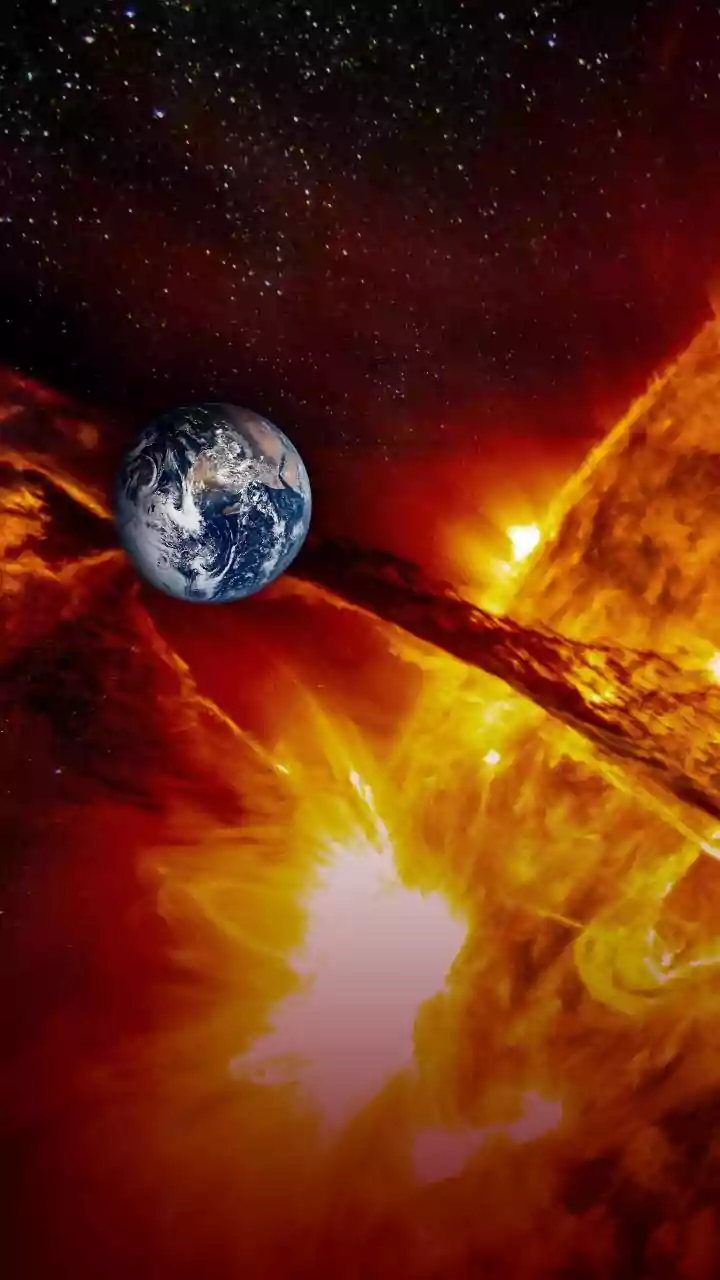
This partnership aims to solve some of the biggest puzzles in solar physics, like the coronal heating problem—why the Sun's atmosphere is millions of degrees hotter than its surface. More pressingly, it helps us understand and predict space weather. CMEs are massive explosions of plasma and magnetic fields from the Sun that can travel towards Earth, potentially disrupting satellites, power grids, and communication systems. By observing CMEs right from their birthplace, scientists can better understand their energy, mass, and trajectory. Early analysis of the joint observations from 2025 has already provided new constraints on how a CME's energy is distributed and evolves, crucial information for improving space weather forecasting.
A Landmark for International Collaboration
The Aditya-L1 and Proba-3 collaboration is more than just a scientific endeavour; it is a significant geopolitical statement. It showcases the value of international cooperation in tackling complex scientific challenges. Workshops jointly organised by ISRO and ESA are already helping scientists from around the world to combine data from the missions, fostering a global research community. For India, ISRO’s ability to not only launch its own advanced solar observatory but also to launch Europe's mission and then partner on the resulting science highlights its arrival as a major and reliable player in global space science. The success of this partnership paves the way for more ambitious joint projects in the future.