



The Universe's Failed Stars
Imagine an object that forms from a collapsing cloud of gas just like a star, but never gathers enough mass to ignite. It glows faintly from its own internal heat but can't sustain the nuclear fusion that powers stars like our sun. This is a brown dwarf,
a mysterious body occupying the middle ground between the largest gas giants, like Jupiter, and the smallest stars. First theorized in the 1960s and confirmed in the 1990s, these objects are sometimes called 'failed stars' or 'super-Jupiters'. Because they are so dim and cool over time, they are incredibly difficult to study, leaving much of our understanding of their nature, including their weather, to theoretical models. Many drift through the cosmos alone, untethered to a host star, making them lonely, dark wanderers.
A New Eye on the Infrared Sky
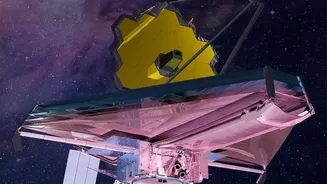
To understand these dim objects, you need a special kind of eye—one that can see in infrared light. That’s where NASA’s Spectro-Photometer for the History of the Universe, Epoch of Reionization, and Ices Explorer, or SPHEREx, comes in. Launched in March 2025, this space telescope is on a mission to map the entire sky in 102 different bands of infrared and visible red light. While its primary goal is to study the origins of the universe and galaxies, SPHEREx is also perfectly suited to investigate the faint heat signatures of brown dwarfs. Infrared light allows astronomers to peer through the layers of their atmospheres, detecting the chemical fingerprints of molecules like water, methane, carbon monoxide, and carbon dioxide.
What We Thought We Knew
For years, astronomers have relied on sophisticated computer models to predict what the atmospheres of brown dwarfs should look like as they age and cool. At the hotter end of their life cycle, models suggested they would have clouds made of silicate particles—essentially fine grains of rock or sand. As the brown dwarf cools over millions of years, these heavy clouds were expected to sink deeper into the atmosphere, eventually clearing up to reveal an atmosphere dominated by methane. This process should follow a relatively predictable path based on the brown dwarf's temperature, gravity, and composition. The models captured this general trend, but the real world, as SPHEREx is now showing, is far messier.
When the Weather Forecast is Wrong
A recent study of 37 nearby brown dwarfs using SPHEREx data has put these models to the test, and they are struggling to keep up. The findings, published in The Astrophysical Journal, revealed that the transition from cloudy to clear skies is far from straightforward. According to Zafar Rustamkulov, the study's lead author, while models capture the general chemical trends, they fail when it comes to the specifics of these 'cloudy transitions'. The data shows that even two brown dwarfs at the exact same temperature can have vastly different spectra, meaning their atmospheres look quite distinct. “No two brown dwarfs are alike,” Rustamkulov stated, highlighting an unexpected level of diversity that current theories cannot explain.
Accidental Meteorologists of the Cosmos
This discovery forces a rethink of how atmospheric dynamics work on these massive objects. The variability suggests that other factors beyond temperature, such as gravity or the presence of heavier elements, play a much larger role than previously appreciated. Scientists on the team have jokingly referred to themselves as 'accidental meteorologists', grappling with the unpredictable weather of these distant worlds. Just as it’s difficult to predict weather on Earth, explaining the atmospheric phenomena on these bizarre, cold objects presents a significant challenge. The study of brown dwarf atmospheres is not just about understanding these failed stars; it also provides a natural laboratory for studying the atmospheric physics of gas giant exoplanets, which are often much harder to observe directly when they orbit a bright star.