



The Fading Giant Next Door
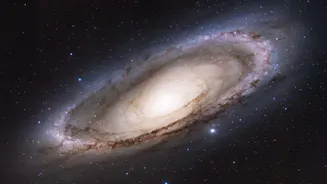
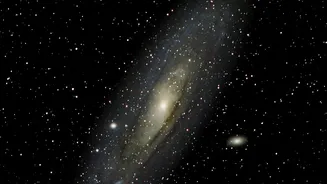
The neighbouring galaxy in question is none other than Andromeda (also known as M31), the largest spiral galaxy in our local cosmic neighbourhood. Located about 2.5 million light-years away, it's so close that it can be seen with the naked eye from dark
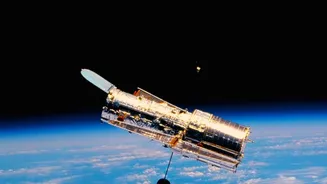
locations. Its grand scale and proximity make it an ideal natural laboratory for astronomers to study galactic evolution, offering a preview of what might be in store for our own Milky Way. A major new study, published in The Astrophysical Journal, used the unparalleled vision of the Hubble Space Telescope to conduct a detailed census of Andromeda's stars, creating a fossil record of its history.
Reading the Fossil Record of Stars
To understand a galaxy's past, astronomers look at its stars. Massive, young stars burn hot and bright, giving off a blue glow, while older, less massive stars have a longer, redder life. By mapping the colour and distribution of stars, scientists can create a timeline of star-forming activity. An international team of researchers analysed data from two of Hubble's largest surveys, measuring nearly 200 million individual stars across two-thirds of Andromeda's disc. This massive stellar census allowed them to pinpoint when and where stars were born over hundreds of millions of years. What they found was a clear and dramatic slowdown in the birth of new suns.
A Galactic Slowdown
The data reveals a steady decline in star formation that began around 500 million years ago. Back then, Andromeda was producing stars at a rate of about one solar mass per year. However, this rate has been falling ever since, with a particularly sharp drop in the last 40 million years. Today, Andromeda's star formation rate has plummeted to just one-fifth of a solar mass annually, its lowest known level. The decline is most pronounced in a large, star-forming ring about 32,000 light-years from the galaxy's centre, which has been a major engine of activity. As this ring quiets down, so does the entire galaxy.
Why is Andromeda Winding Down?
Interestingly, Andromeda is not running out of the raw materials—gas and dust—needed to create new stars. Instead, the decline appears to be a natural part of its life cycle, like an athlete taking a breather after a marathon, as one researcher put it. This quiet period follows a dramatic burst of star birth that happened about 2 billion years ago, likely triggered by a close encounter or merger with another, smaller galaxy. Astronomers also suspect a more recent interaction with M32, one of Andromeda's small satellite galaxies, may have played a role. They found a noticeable decrease in star formation in the part of Andromeda's disk closest to M32, suggesting an interaction around 60 million years ago may have disrupted the stellar nurseries there.
A Glimpse into Our Future
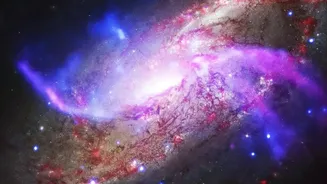
Studying Andromeda's 'middle age' offers clues about the long-term future of our own Milky Way. Like Andromeda, our galaxy is a spiral that is expected to eventually exhaust its star-forming capabilities and transition into a more quiescent state. This process, known as 'quenching', is a key focus for astronomers trying to understand why some galaxies remain active while others simply fade away. While dramatic events like mergers can play a role, this new evidence from Andromeda suggests that a long, slow decline may be a more common path for massive galaxies as they age. It's a reminder that even on the grandest scales, everything in the universe has a life story with a beginning, a middle, and an end.