






From Pluto's Heart to a New Target
The flyby of Pluto was a monumental success, revealing a world far more complex and active than ever imagined, with vast nitrogen-ice glaciers, towering water-ice mountains, and a potential subsurface ocean. After rewriting the textbooks on the dwarf
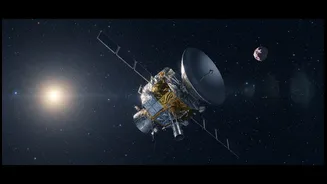
planet, the mission team at Johns Hopkins Applied Physics Laboratory had a new question: what's next? The spacecraft was healthy and speeding through the Kuiper Belt, a vast, donut-shaped region of icy bodies beyond Neptune. Mission planners redirected New Horizons toward a new, much smaller target, a primordial object known as Arrokoth.
A Rendezvous in the Kuiper Belt
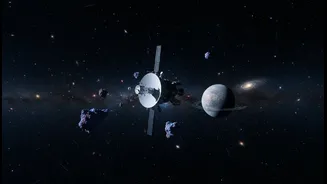
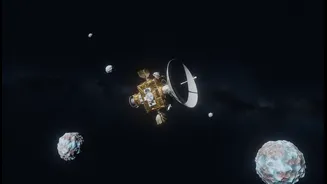
On January 1, 2019, New Horizons made history again, conducting the most distant flyby ever when it encountered Arrokoth, a billion miles beyond Pluto. The images revealed a bizarre, reddish object shaped like a flattened snowman, about 33 kilometers long. Scientists believe Arrokoth is a contact binary—two separate objects that gently spiraled toward each other and merged shortly after the solar system's birth 4.5 billion years ago. Because it has remained in the cold, dark deep freeze of the Kuiper Belt, it is considered a perfectly preserved building block of the planets, offering a pristine glimpse into our solar system's formation.
A Lonely Observatory in the Dark
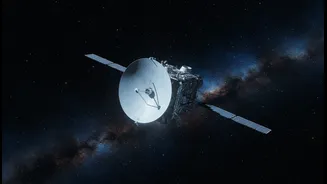
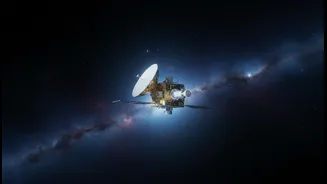
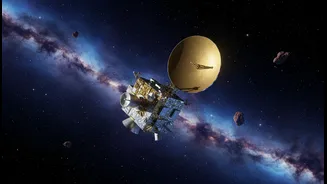
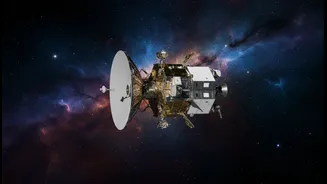
With no more flyby targets in its path, New Horizons has transformed into a unique deep-space observatory. As of early July 2026, the spacecraft woke from a nearly year-long hibernation and resumed its science mission approximately 9.5 billion kilometers from Earth. While some of its systems sleep to conserve power, key instruments continue to measure the particles and dust in its environment. This makes it the only active probe gathering data from this remote region, offering a perspective that is impossible to get from Earth. Its current tasks include studying the faint ultraviolet glow of hydrogen from the outer solar system and measuring the true darkness of the space between stars.
Racing Toward the Sun's Final Frontier
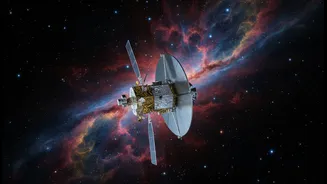
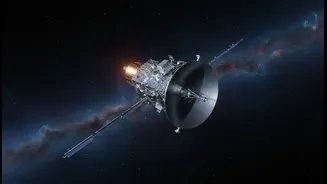
The spacecraft's ultimate destination is the heliopause, the boundary where the Sun’s influence ends. Our star constantly emits a stream of charged particles called the solar wind, creating a massive protective bubble around the solar system called the heliosphere. This bubble shields us from harsh galactic cosmic radiation. As New Horizons travels at about 480 million kilometers per year, it measures how the solar wind slows down as it interacts with gas from interstellar space. Scientists predict it could cross the first major boundary, the termination shock, sometime between 2029 and 2040. This will make it only the third operational spacecraft, after Voyagers 1 and 2, to probe this mysterious frontier.
An Emissary into the Galaxy
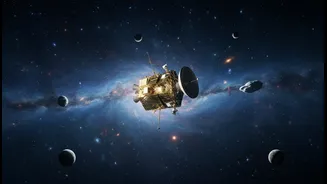
New Horizons is powered by a radioisotope thermoelectric generator, which provides electricity from the heat of decaying plutonium. Its power is slowly diminishing, and its mission is expected to continue until it exits the Kuiper Belt around 2028 or 2029, though it may operate for decades longer. Eventually, after its instruments fall silent, the spacecraft will continue its journey, coasting silently into interstellar space. Like the Voyager probes with their Golden Records, New Horizons carries a small collection of mementos from Earth, including a Florida state quarter and some of Clyde Tombaugh's ashes, the astronomer who discovered Pluto. It will become a silent ambassador, a testament to human curiosity journeying through the Milky Way for millions of years to come.