






The Houseplant We All Know and Love
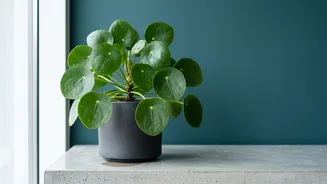
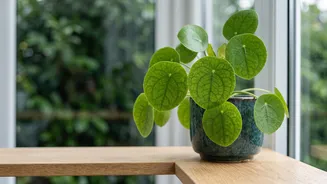
Known scientifically as Pilea peperomioides, but more affectionately as the Chinese Money Plant, Pancake Plant, or Friendship Plant, this species has become a staple of modern indoor gardening. Its appeal is obvious: distinctive, circular green leaves
are held aloft on slender stems, creating a clean, graphic silhouette. Originally from the mountain regions of southern China, its journey into our homes was less about commercial trends and more about sharing. For decades, it was passed from friend to friend as a cutting or offset, earning its place on shelves and in bright corners through a quiet network of plant lovers. Its rapid growth and the 'pups' it sends up make it a satisfying plant to nurture, but its most fascinating feature is one you might not notice at first glance.
A Mathematical Pattern Hiding in Plain Sight
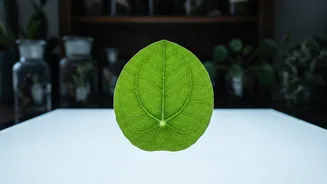
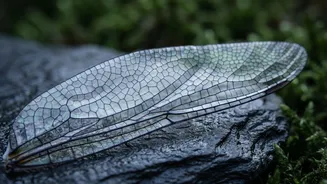
If you look closely at a Pilea leaf, you’ll see the delicate network of veins. Recent research has revealed that this isn't just a random arrangement. The pattern of the major veins forms what is known as a Voronoi diagram. This might sound complex, but the concept is beautifully simple. Imagine a number of points scattered on a map. A Voronoi diagram divides the map into regions, or 'cells', where every spot inside a cell is closer to that cell's central point than to any other. Think of it like mapping school districts, where each house is assigned to the nearest school. In nature, similar patterns appear in giraffe coats, dragonfly wings, and even the structure of biological cells. It's a fundamental way that nature divides space efficiently.
The Leaf's Secret Algorithm
So, how does a humble plant leaf create such a sophisticated mathematical pattern? The 'central points' in the leaf's Voronoi diagram are tiny pores called hydathodes, which are used to secrete water. During the leaf's development, waves of a plant hormone called auxin appear to spread out from each of these pores. The veins form along the lines where these waves meet—essentially, the boundaries of each Voronoi cell. This process is an example of a 'natural algorithm'. The plant isn't 'thinking' or 'calculating' distances. Instead, it follows a simple set of local biological rules: hormones are released, cells react, and a complex, globally organised pattern emerges as a result. This challenges older ideas about how such looped vein networks form, suggesting a new paradigm for understanding plant development.
Why Does Nature Use This Pattern?
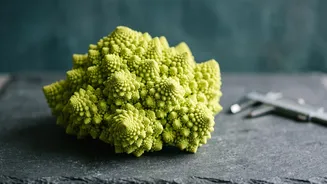
The prevalence of Voronoi-like patterns in nature points to their efficiency. For the Chinese Money Plant, this layout might serve a practical purpose. One theory suggests that by keeping the major veins—the primary water transporters—as far as possible from the hydathodes where water is lost, the plant optimizes its internal plumbing. It's a clever biological strategy to manage resources effectively. This kind of emergent patterning is a hallmark of natural design, solving problems without a central planner. From the branching of our lungs to the spirals in a sunflower, nature uses these 'algorithms' to create structures that are both beautiful and highly functional. The Chinese Money Plant is a perfect, living example of this principle at work.