






The Arctic’s Cloudy Conundrum
For decades, scientists have grappled with the complex role of Arctic clouds. Unlike clouds in warmer climates, those in the polar regions can have a dual personality. Depending on the season, their altitude, and their composition—whether they are made
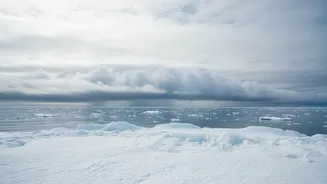
of water droplets or ice crystals—they can either reflect sunlight back into space, creating a cooling effect, or trap heat radiating from the surface, acting like a blanket and warming the region below. Understanding which effect will dominate is one of the most significant challenges in climate modeling. Accurately predicting the future of the Arctic, and by extension the global climate, depends on solving this cloudy puzzle.
A Surprising Discovery at the Ice Edge
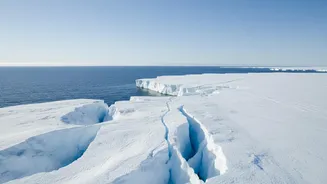
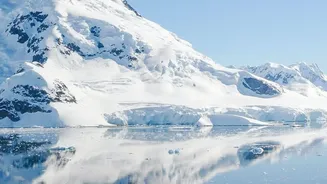
A recent study published in Nature Geoscience has shed new light on this issue, uncovering a potent natural process that was previously unknown. An international team of researchers found that the marginal ice zone—the dynamic boundary where open ocean meets melting sea ice—is a hotspot for producing huge numbers of cloud-forming particles. During an expedition around Greenland, they observed that where ice, ocean, and sunlight meet, a chemical cocktail is released into the atmosphere. In one instance, the number of particles capable of seeding clouds increased an astonishing fifty-fold in a single day, jumping from around 50 to 1,500 per cubic centimeter.
From Marine Life to the Sky
So, what are these particles and where do they come from? The study pinpointed a powerful combination of iodine, sulfur, and organic compounds. As the sea ice melts, it exposes ocean water that is rich in marine life, like algae. These microscopic organisms release sulfur compounds. Simultaneously, the sea ice and seawater release iodine. When sunlight hits this mixture, it triggers a chemical reaction that creates brand-new particles in the atmosphere. These tiny particles, far smaller than a human hair, act as 'cloud condensation nuclei'—the essential seeds around which water vapor can condense to form cloud droplets.
A Feedback Loop We Can't Ignore
This discovery validates a mechanism previously only seen in lab experiments at CERN, confirming it happens in the real world. The implications are profound. As the Arctic warms and more sea ice melts each summer, the marginal ice zone expands, meaning this cloud-seeding process is likely becoming more widespread and intense. This creates a complex feedback loop. More particles could lead to more or thicker clouds. During the sunlit summer, these clouds might cool the open ocean by reflecting sunlight, but over the remaining ice, they could trap heat and accelerate melting. It's a delicate balance with significant consequences for the pace of Arctic change.
Why It Matters for Climate Models
Crucially, this entire chemical pathway is currently missing from the climate models we rely on to project the future. By not accounting for this powerful source of cloud-seeding particles, our forecasts for the region may be incomplete. As Professor Zongbo Shi of the University of Birmingham, who led the study, noted, understanding these natural processes is vital for determining how climate change will affect the Arctic and, in turn, how the Arctic will influence the global climate. The discovery highlights the intricate and often surprising connections within Earth's systems, where melting ice can directly influence the sky above it.