



A Cosmic Disappearing Act
Imagine looking up at the night sky, charting the position of a colossal, brightly burning star, only for it to disappear from view without a trace. This is the real-life puzzle that has stumped astronomers for years. Massive stars, specifically those
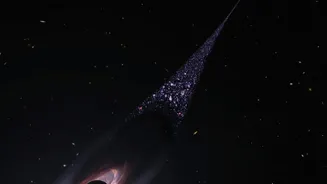
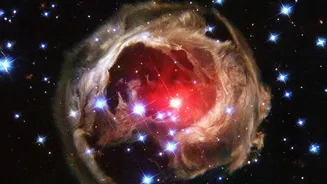
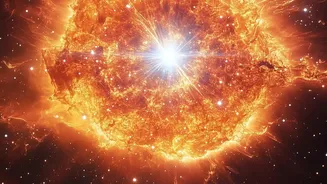
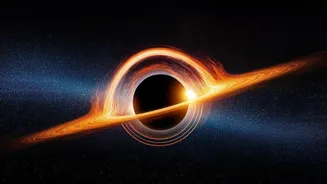
known as red supergiants, are expected to end their lives in one of the universe's most spectacular events: a supernova explosion. Yet, observations have shown a curious deficit. There are fewer observed supernovae than theories predict, and in some cases, a known red supergiant appears to simply vanish, leaving behind no explosive signature. These are dubbed 'failed supernovae,' where a star massive enough to go out with a bang instead seems to fizzle out, collapsing directly into a black hole with barely a whisper. The question has always been, why?
The Life and Death of Stellar Giants
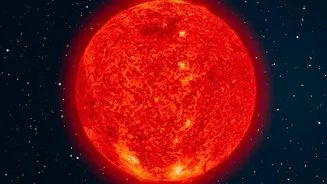
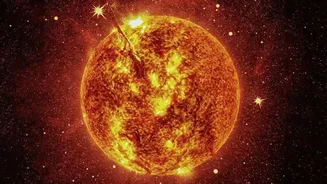
Red supergiants are the largest stars in the universe by volume. A star like Betelgeuse in the constellation of Orion is a prime example; if it were in our solar system, its outer layers would extend past the orbit of Jupiter. These giants are in the final stages of their life, having exhausted the primary fuel in their cores. For millions of years, they fused hydrogen into helium. Now, in their final millennia, they furiously burn through heavier elements. According to standard models, this process culminates when the core becomes iron. Iron fusion consumes energy rather than releasing it, causing the star's internal furnace to shut down. Gravity then wins the final battle, causing the core to collapse catastrophically, triggering a rebound shockwave that blasts the star's outer layers into space in a brilliant supernova. But recent findings suggest this process is more sensitive than once believed.
Enter the 'Ghost Particle'
The key to this mystery may lie with one of the most elusive and abundant particles in the universe: the neutrino. Trillions of neutrinos from the Sun pass through your body every second, yet they barely interact with matter, earning them the nickname 'ghost particles'. In the extreme environment of a collapsing star core, however, their role is anything but ghostly. When a star's core implodes, it releases an unimaginable flood of neutrinos, which carry away about 99% of the collapse energy. For a long time, scientists thought the specific type, or 'flavour', of these neutrinos didn't significantly alter the outcome. But new research suggests that's wrong.
The Great Neutrino Heist
A recent study from the Niels Bohr Institute suggests that the way neutrinos change their flavour inside the dying star can decide its ultimate fate. Under certain conditions, especially in the most massive stars, neutrinos can interact with each other in the ultra-dense core, triggering rapid flavour changes. This conversion can dramatically alter how they transfer energy to the rest of the star. Instead of providing the crucial 'kick' needed to power a supernova explosion, the neutrino activity can fail to produce a sufficient shockwave. Without that explosive push, gravity's victory is absolute. The star's core and its outer layers collapse unimpeded, forming a black hole directly. The star effectively swallows itself, vanishing from sight without the tell-tale supernova flash. This 'neutrino heist' of energy provides a compelling physical mechanism for the failed supernovae astronomers have been hunting.
No Danger to Our Cosmic Neighborhood
While the idea of a star collapsing into a black hole sounds alarming, this finding poses absolutely no risk to Earth. The stars massive enough to undergo this process are many light-years away. The most famous nearby red supergiant, Betelgeuse, is over 600 light-years from us. Even if it were to explode or collapse, it is far too distant to cause any harmful effects on our planet or solar system. Scientists estimate a supernova would need to be within 25 light-years to cause a major extinction event, and there are no such candidates nearby. Our own Sun is not massive enough to become a red supergiant or explode as a supernova; in about 5 billion years, it will swell into a regular red giant before eventually becoming a white dwarf, a process that poses a long-term threat to Earth but is unrelated to these massive stellar collapses.