






Meet the 'Lunar Cruiser'
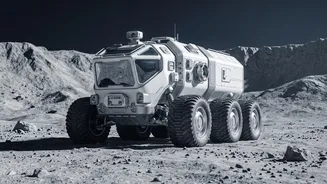
Japan, in partnership with NASA, is developing a crewed, pressurized lunar rover nicknamed the 'Lunar Cruiser'. The name, a nod to Toyota's iconic Land Cruiser, was chosen to evoke a sense of reliability and familiarity. But this is no ordinary off-road
vehicle. Developed jointly by the Japan Aerospace Exploration Agency (JAXA) and Toyota, the Lunar Cruiser is essentially a mobile habitat designed for the harsh lunar environment. Sized roughly like two small buses, it will provide a shirt-sleeve environment for astronauts, allowing them to live and work for extended periods without the constant constraint of a spacesuit.
A Game-Changer for Lunar Exploration
The key innovation of the Lunar Cruiser is its pressurized cabin. This feature transforms the nature of lunar exploration. Instead of short excursions limited by the oxygen supply in a spacesuit, two astronauts will be able to live and operate inside the rover for up to 30 days at a time. This allows for expeditions covering vast distances, potentially thousands of kilometres over the vehicle's expected 10-year lifespan. It will function as a mobile home, laboratory, and outpost, enabling astronauts to travel to diverse geological sites far from their landing zone, conduct complex science, and scout for resources like water ice, particularly around the Moon's strategic South Pole.
The Power of Partnership
This advanced rover is the centerpiece of a historic agreement between the United States and Japan, signed in April 2024. Under the arrangement, Japan will design, develop, and operate the Lunar Cruiser. In return, NASA will provide the launch and delivery of the rover to the Moon and, significantly, will give two Japanese astronauts rides to the lunar surface on future Artemis missions. The agreement includes the shared goal for a Japanese astronaut to become the first non-American to walk on the Moon. This collaboration is a cornerstone of the Artemis Program, which emphasizes international partnership as essential for creating a sustainable and peaceful human presence in deep space.
Technology for a New World
The Lunar Cruiser will be a marvel of engineering, built to withstand the extreme conditions of the Moon: a near-vacuum, temperatures swinging from 120 to -170 degrees Celsius, and intense radiation. It will employ regenerative fuel cell technology, using solar panels to create electricity by electrolyzing water, then generating power from the resulting hydrogen and oxygen. Toyota is also developing advanced autonomous driving capabilities and specialized tires to navigate the treacherous, sandy lunar terrain, or regolith. These systems will help ensure astronaut safety and automate much of the navigation, freeing up the crew for scientific work.
A Critical Piece of the Artemis Puzzle
The Lunar Cruiser isn't just a vehicle; it's a foundational element of NASA's long-term Artemis architecture. While early missions will rely on landers for short stays, establishing a true lunar base requires mobility and long-duration habitats. The rover is slated for use starting with the Artemis VII mission, planned for the early 2030s. Its ability to be operated remotely between crewed missions also means it can be pre-positioned at future landing sites or used for telerobotic science, maximizing its utility. By enabling long-range, long-duration surface missions, the Lunar Cruiser bridges the gap between temporary visits and a permanent human foothold on another world.