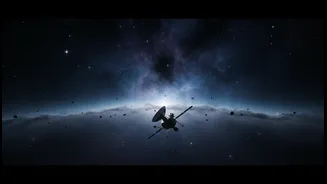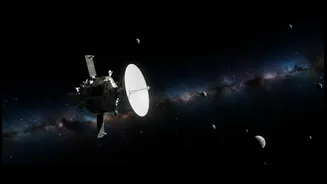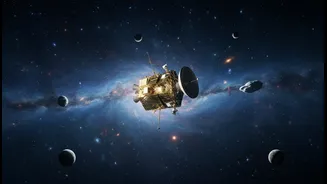








A Landmark Journey So Far
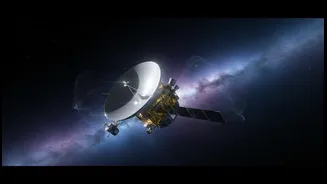
Launched in 2006, New Horizons first etched its name in history in July 2015 when it flew past Pluto. For decades, Pluto was just a fuzzy point of light, but New Horizons transformed it into a complex world with vast nitrogen-ice glaciers, water-ice mountains,
and a surprisingly layered atmosphere. The data it sent back fundamentally rewrote our understanding of dwarf planets. But the mission team wasn't done. They steered the probe deeper into the Kuiper Belt, a vast ring of icy bodies left over from the solar system's formation. On January 1, 2019, New Horizons made history again by flying past Arrokoth, a primordial object that looked like two pancakes stuck together, offering an unprecedented glimpse into the building blocks of planets.
A New Mission in Deep Space
After the Arrokoth flyby, New Horizons entered its Kuiper Belt Extended Mission. With no more close-up targets currently in its path, the spacecraft’s purpose has shifted. It is no longer a planetary encounter mission but a deep-space observatory, uniquely positioned to conduct science no other active probe can. Recently, on July 7, 2026, NASA announced that New Horizons had awakened from a 321-day hibernation, its longest yet, in good health. Now nearly 6 billion miles from Earth, so far that its signals take almost nine hours to reach us, it is ready for the next chapter of its life: studying the very nature of our solar system's border.
Decoding the Sun's Neighborhood
The spacecraft’s new focus is on heliophysics—the study of the Sun and the massive bubble of charged particles and magnetic fields it creates, known as the heliosphere. This bubble shields our solar system from much of the harsh interstellar radiation. New Horizons is flying through the outer heliosphere, a region far beyond Neptune that has been visited by very few spacecraft. Its instruments, like the Solar Wind Around Pluto (SWAP) and the Pluto Energetic Particle Spectrometer Science Investigation (PEPSSI), are measuring how the solar wind, a stream of particles flowing from the Sun at a million miles per hour, slows down and interacts with gas from interstellar space. This data provides a crucial third data point, alongside the aging Voyager 1 and 2 probes, helping scientists understand the structure and behavior of our cosmic neighborhood.
Hunting for the Termination Shock
The ultimate goal is to find the "termination shock." This is the boundary where the Sun's solar wind, after traveling billions of miles, abruptly slows down from supersonic to subsonic speeds as it collides with the pressure of the interstellar medium. The Voyager probes crossed this boundary, but New Horizons carries more modern instruments, allowing for more sensitive measurements. Scientists are using the probe’s data to create models predicting where this invisible wall is. Current estimates suggest New Horizons could cross the termination shock sometime between 2029 and 2040. Because the heliosphere expands and contracts with the Sun's activity cycle, the probe might even cross the boundary more than once.