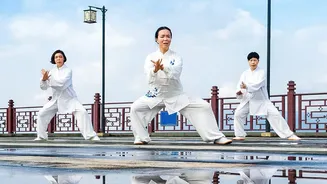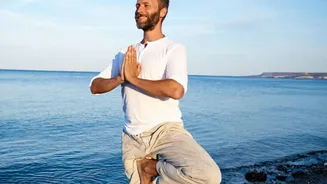





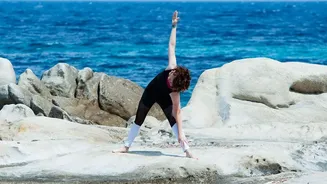

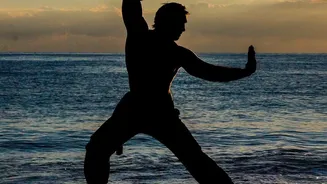
The Allure of the Open Air
Taking any wellness practice outdoors offers a distinct advantage. The simple act of being in nature—surrounded by fresh air, natural light, and open space—can lower stress and improve mood. For a discipline like Tai Chi, which is fundamentally about
aligning the body and mind with natural principles of balance and flow, the connection feels even more profound. The beach, with its vast horizon and rhythmic sounds, seems like the ultimate classroom. The constant, soothing sound of waves can act as a natural metronome, helping to guide the breath and pace of your movements, while the fresh ocean air encourages deeper, more expansive breathing. It’s an invitation to break free from the four walls of a studio and connect with the elements in a powerful, direct way.
A Sharper Sense of Focus
Here's where the beach reveals its first surprising benefit: it is a formidable training ground for focus. The primary reason is the ground beneath your feet. Unlike a flat studio floor, sand is an unstable, shifting surface. This forces your body to make constant micro-adjustments to maintain balance. Your feet, ankles, and core muscles must engage more deeply to keep you rooted and stable as you flow through the forms. This physical demand requires immense concentration. You cannot simply go through the motions; you must be intensely present, feeling the connection between your soles and the earth. This heightened need for physical awareness sharpens mental focus, pulling your mind away from distracting thoughts and anchoring it firmly in the present moment and the movement itself.
The Relaxation Paradox
If the practice demands so much focus, why doesn't that automatically translate to deep relaxation? The answer lies in the very same challenges that build concentration. For one, the physical effort required to stay balanced on sand can be tiring. While it builds strength, the muscular engagement can create a subtle tension that works against the Tai Chi principle of 'fangsong', or letting go of all physical and mental tension. Furthermore, a beach, even a quiet one, is a public space. For some practitioners, particularly those newer to the art, the feeling of being observed can create a sense of self-consciousness that inhibits the ability to fully relax and immerse oneself in the practice. Environmental factors like strong wind, the hot sun, or even insects can also serve as physical irritants, preventing the mind and body from settling into a state of complete ease. Meditation in nature, while beautiful, isn't always easy and requires practice to tune out distractions.
Finding Your Flow by the Shore
Understanding this distinction between focus and relaxation is key to getting the most out of beach-side Tai Chi. It's not about achieving a perfect, blissful state, but about using the environment as a tool. To make it work for you, consider a few adjustments. Try practicing on damp, compacted sand near the water's edge for a more stable surface. Choosing sunrise or sunset can help you avoid crowds and intense heat. Most importantly, set a clear intention. Are you there to challenge and refine your balance and focus? Or are you seeking gentle, restorative movement? If your goal is relaxation, you might choose simpler Qigong breathing exercises over a complex Tai Chi form. By acknowledging that the beach can serve different purposes on different days, you can embrace its unique offerings without feeling frustrated if it doesn't feel like a spa day. The goal is to listen to your body and adapt, just as you adapt to the shifting sands.