
Our Cosmic Next-Door Neighbour
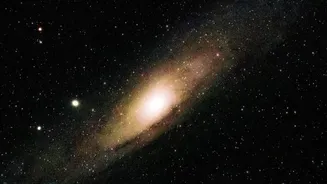
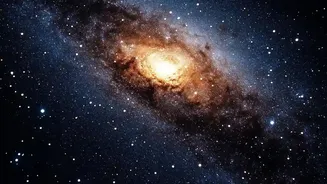
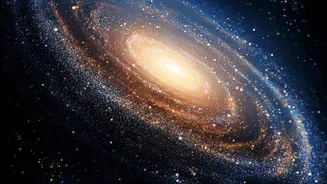
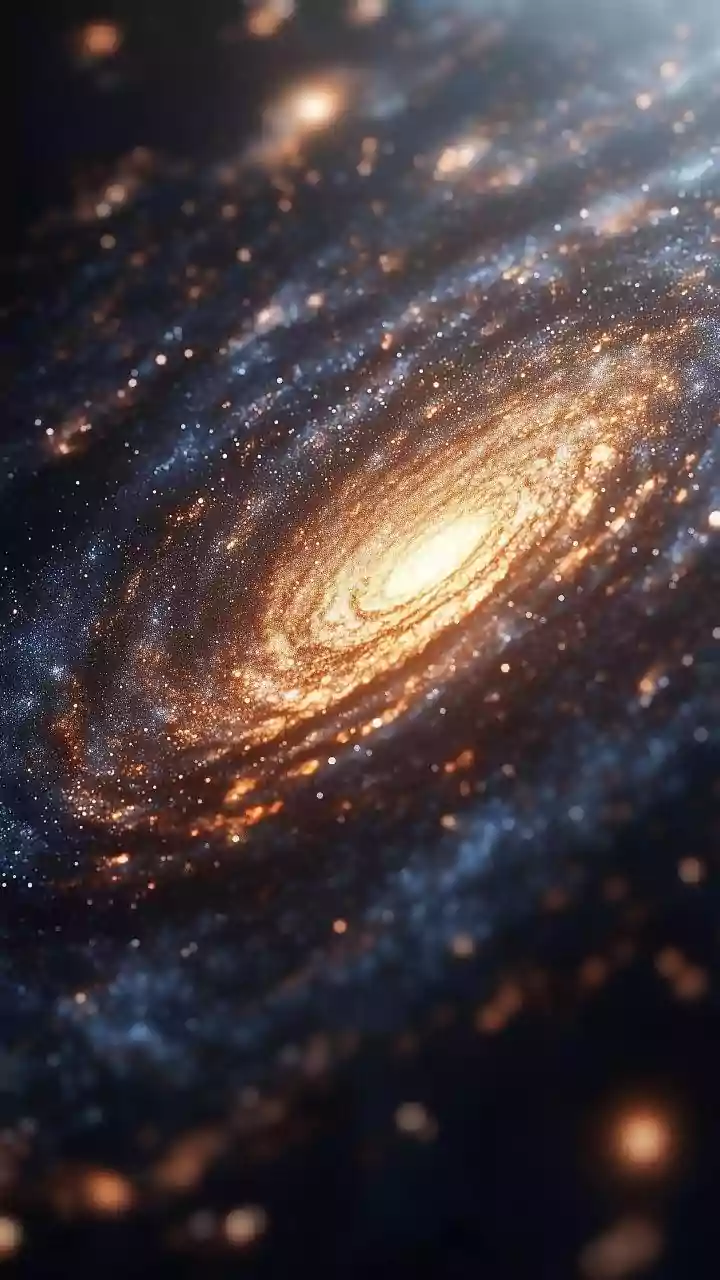
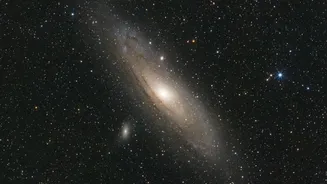
At 2.5 million light-years away, the Andromeda galaxy (M31) is the closest major spiral galaxy to our own Milky Way. This proximity makes it a unique natural laboratory for astronomers. It’s near enough for the powerful Hubble telescope to resolve individual
stars from its sprawling disk, yet far enough that we can get a complete, panoramic view of the entire galaxy—a perspective we can never get of our own from within. For decades, scientists have studied Andromeda to better understand how large galaxies like our own form, grow, and evolve. By reading the 'fossil record' left by its one trillion stars, we can piece together its dramatic past.
Hubble's Unprecedented Star Census
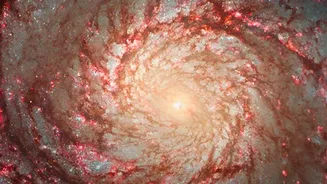
To decode Andromeda's history, astronomers launched one of the most ambitious projects in Hubble's history: the Panchromatic Hubble Andromeda Treasury (PHAT). This massive survey mapped roughly two-thirds of Andromeda's star-forming disk, capturing images of over 200 million individual stars across multiple wavelengths of light, from ultraviolet to near-infrared. By analysing the colour and brightness of these stars, scientists can determine their age. Younger, more massive stars burn hot and blue, while older, less massive stars are cooler and redder. By mapping out the locations of these different stellar populations, researchers created a detailed timeline of star-forming activity across the galaxy.
A Galaxy Winding Down
The study's most striking revelation is that Andromeda's star-making days are slowing down. While previous research knew of a massive burst of star formation about 2 billion years ago, the new data shows a steady decline since then. About 500 million years ago, Andromeda was forming stars at a rate of about one solar mass per year, similar to the Milky Way today. But that rate has been dropping. It halved by 40 million years ago and has now plummeted to just one-fifth of a solar mass per year. The decline became especially sharp in the last 40 million years, suggesting the galaxy is entering a quieter phase of its life.
The Fading Ring of Fire
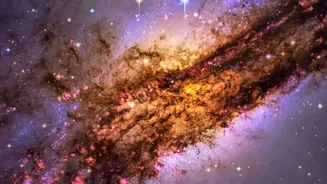
The slowdown isn't happening uniformly across the galaxy. Much of the recent star-making activity has been concentrated in a massive ring of gas and dust about 32,000 light-years from the galactic centre. This 'ring of fire' was once a hyperactive stellar nursery, responsible for a large percentage of all new stars born in Andromeda. The new Hubble data shows that the decline in this ring's activity is the primary driver of the galaxy-wide slowdown. Rather than running out of the gas needed to form stars, it seems the galaxy is simply taking a natural 'breather' after a more energetic past.
A Case of Galactic Bullying?
Another intriguing clue comes from the influence of M32, a small, compact satellite galaxy that orbits Andromeda. Astronomers have long suspected that M32 may have interacted with Andromeda's disk in the past. The Hubble study found that the region of Andromeda's disk closest to M32 showed a more pronounced decrease in star formation starting around 60 million years ago. While astronomers can't definitively say M32 is the cause, its presence in the right place at the right time makes it the 'most likely suspect' for suppressing star birth in that area.
Why These Changes Matter
Understanding the peaks and troughs of Andromeda's star formation provides a crucial template for galaxy evolution. It shows that star birth is not a constant, steady process but happens in bursts and lulls, often influenced by galactic mergers and interactions. These findings challenge older models that assumed a more stable rate of star formation and help refine our methods for studying distant galaxies where we can't see individual stars. By studying Andromeda's past and present, we gain invaluable insight into the likely future of our own Milky Way, which is on a collision course with Andromeda billions of years from now.