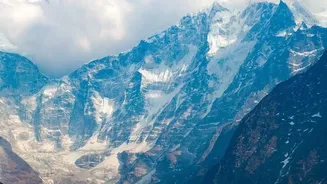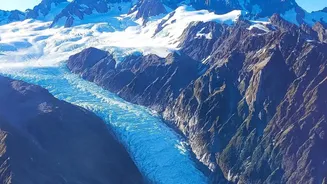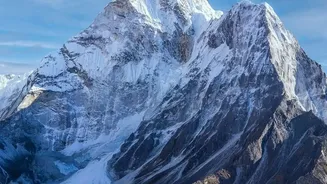


First, What Is a Hanging Glacier?
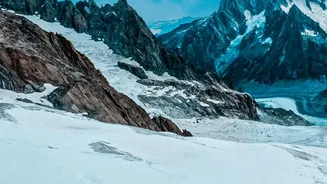
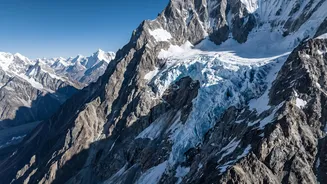
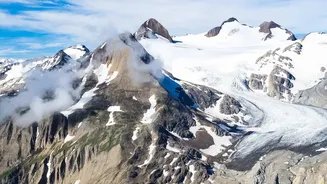
Imagine a river of ice that doesn't quite reach the main valley floor. That's a hanging glacier. It's a glacier that originates high up on a steep mountain wall and terminates abruptly, often at a cliff edge, suspended high above the valley below. Unlike
larger valley glaciers that flow downwards gradually, these hanging masses are in a precarious position. Their only way to transfer ice and snow to the valley below is through dramatic, and often dangerous, avalanches and icefalls. This inherent instability makes them a significant point of concern, especially in a warming climate.
The Breaking Point: Why Do They Collapse?
A hanging glacier's collapse isn't a random event; it's a failure of physics driven by changing conditions. The primary culprit is rising temperature. As the climate warms, especially in the Himalayas which are heating at nearly twice the global average, the ice that glues the glacier to the bedrock can weaken. Meltwater seeps into cracks, lubricating the base and making it easier for the ice to slide. Repeated cycles of freezing and thawing can further destabilize the ice mass. In some cases, the permafrost—the permanently frozen ground beneath the glacier—can thaw, reducing the stability of the entire mountain slope. This combination of factors erodes the glacier's grip, making a catastrophic break increasingly likely.
The Initial Catastrophe: An Ice-Rock Avalanche
When a hanging glacier finally gives way, the immediate result is a colossal ice and rock avalanche. Millions of tonnes of ice, mixed with rock and debris torn from the mountainside, plummet down the steep slopes under the force of gravity. The energy released is enormous; one recent collapse in the Himalayas was estimated to have the force equivalent to a magnitude 5.2 earthquake. This mass of material travels at incredible speeds, pulverizing everything in its path and transforming into a fast-moving, destructive torrent. The sheer friction from the fall can generate enough heat to melt a significant portion of the ice instantly, adding water to the deadly mix.
The Secondary Disaster: A Cascade of Water
The danger rarely ends with the initial avalanche. This mass of ice and debris often crashes into a river valley below, with devastating secondary effects. It can temporarily block the river's flow, creating a natural dam. Behind this unstable barrier, water begins to build up rapidly. Eventually, the immense pressure causes the dam to breach, unleashing what's known as a Glacial Lake Outburst Flood, or GLOF. This is a sudden, violent release of a huge volume of water, now mixed with the debris from the avalanche. This slurry, which can resemble liquid concrete, surges downstream, often rising metres in minutes and carrying a destructive power far greater than a normal flood.
The Devastating Downstream Impact
The consequences for communities downstream are catastrophic. The GLOF can travel for hundreds of kilometres, destroying villages, bridges, roads, and critical infrastructure like hydropower plants. The 2021 Chamoli disaster in Uttarakhand is a stark example, where a hanging glacier collapse led to a flood that killed over 200 people and wiped out two power projects. Recent events in Nepal in August 2026 have shown similar patterns, with water levels rising by up to 9 metres in just 30 minutes, sweeping away entire settlements. These events underscore the vulnerability of the growing populations and infrastructure located in these mountain regions.