


A Galaxy's Fossil Record
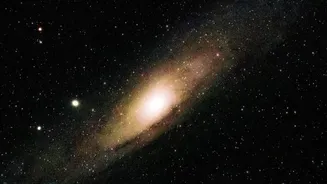
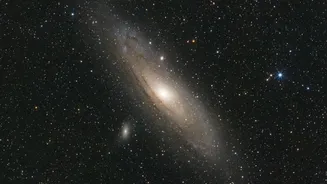
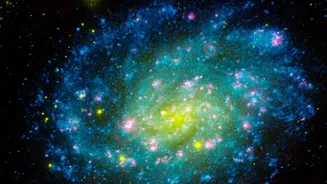
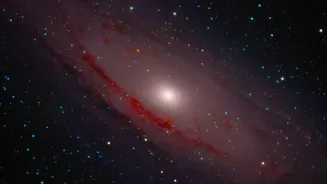
The Andromeda galaxy, located a mere 2.5 million light-years away, offers astronomers a unique opportunity. It’s close enough for the Hubble Space Telescope to resolve hundreds of millions of individual stars, yet far enough away to capture a bird's-eye
view of its entire structure—a perspective we can never get of our own Milky Way from the inside. A recent study, published in The Astrophysical Journal in July 2026, took advantage of this proximity by analyzing data from two massive Hubble surveys: the Panchromatic Hubble Andromeda Treasury (PHAT) and its southern counterpart, PHAST. By mapping about two-thirds of the galaxy's sprawling disk and analyzing some 200 million stars, scientists have effectively read Andromeda’s stellar fossil record. They did this by looking at the color of stars; massive, young stars burn hot and appear blue, while older, less massive stars are redder and live longer. This allows astronomers to create a detailed timeline of when and where stars have formed throughout the galaxy's history.
The Slowing Factories of Andromeda
The study revealed a significant and steady decline in star formation over the last 500 million years. While scientists already knew Andromeda experienced a major burst of star birth about two billion years ago, this new analysis shows the aftermath. Around 500 million years ago, Andromeda was churning out stars at a rate of about one solar mass per year, similar to the Milky Way's current output. However, by 40 million years ago, that rate had been cut in half. Today, it has plummeted to just one-fifth of a solar mass per year, indicating a galaxy that is becoming increasingly quiet. Much of this slowdown is concentrated in a prominent ring of gas and dust about 32,000 light-years from the galactic center, which was once a hotbed of stellar nurseries. Astronomers suggest this is likely a natural 'breather' after a more active past. The slowdown may have also been influenced by a past interaction with M32, a dwarf galaxy that is Andromeda's satellite, though the link is not yet definitive.
A Universal Trend
Andromeda’s story is not an isolated one. Its gentle decline is a local example of a much grander, universe-wide phenomenon. The rate of star formation across the entire cosmos has been falling for about 10 billion years. The universe experienced a 'cosmic noon' around 3 to 4 billion years after the Big Bang, a frenetic period when stars were being born at a rate up to 30 times higher than what we see today. This was the era when most of the stars in galaxies like our own were formed. Since that peak, however, the universe has entered a long, slow twilight. The expansion of the universe spreads galaxies and the gas between them farther apart, making it harder for the raw materials of star birth to collect. Existing galaxies are also gradually using up their reservoirs of cold gas, the essential fuel for creating new stars. Today, the cosmic star formation rate is just a fraction of what it was at its peak.
A Tale of Two Galaxies
While both the Milky Way and Andromeda are large spiral galaxies in the same Local Group, their histories are distinct. The Milky Way is considered a more steadily productive galaxy, consistently forming one to two new stars each year. In contrast, Andromeda appears to have had a more dramatic past, with intense bursts of activity followed by quieter periods. Evidence suggests Andromeda's disk is twice as massive as the Milky Way's and that it had a higher overall star formation efficiency in its past. Yet, its current state is far more sluggish than our own. By studying our neighbor in such detail, we learn not only about the life cycle of a single galaxy but gain invaluable context for our own. Andromeda acts as a proxy, helping us understand how spiral galaxies evolve and allowing us to place the Milky Way's own history within a broader cosmic framework.