




What Exactly Is a 'Fire Rainbow'?
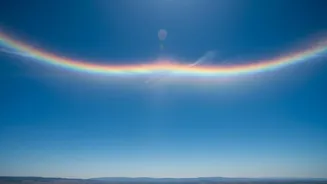
The captivating phenomenon often called a “fire rainbow” for its flame-like, vibrant colours is known in scientific circles as a circumhorizontal arc. Unlike a traditional rainbow that arcs across the sky, a circumhorizontal arc is a broad, colourful
band that runs parallel to the horizon. The name is a popular misnomer, as the event is caused by ice, not fire, and its formation is distinctly different from that of a rainbow. The term arose simply because its wispy, iridescent appearance can resemble a colourful flame in the sky. NASA's Astronomy Picture of the Day for August 2, 2026, featured a brilliant example of this arc, reminding us of the beautiful and precise physics constantly at play in our atmosphere.
The Three Essential Ingredients
For a circumhorizontal arc to paint the sky, a trio of highly specific conditions must be met. First, you need the right kind of clouds: high-altitude, wispy cirrus clouds. These clouds, floating more than 6,000 meters above the ground, are composed not of water droplets but of tiny ice crystals. Second, these ice crystals must be a particular shape—flat, hexagonal plates—and they must be oriented just right, floating horizontally like tiny dinner plates suspended in the atmosphere. If they are randomly oriented or are column-shaped, the effect won't occur. This precise alignment is a key reason the phenomenon is so uncommon. The third and most crucial ingredient, however, is the position of the sun.
Why the Sun's Angle Is the Deciding Factor
The headline is right to give the sun's angle more weight, because it is the ultimate deciding factor. For a circumhorizontal arc to form, the sun must be incredibly high in the sky—at an elevation of at least 58 degrees above the horizon. This is the non-negotiable rule. If the sun is any lower, the geometry is simply wrong for the light to pass through the ice crystals correctly. Light must enter the vertical side face of the hexagonal crystal and exit through the horizontal bottom face. This 90-degree path acts like a prism, splitting the sunlight into its constituent colours and creating the vibrant spectrum we see. If the sun is below 58 degrees, the light cannot make this journey and the arc will not appear.
How It Differs From a Regular Rainbow
While both phenomena create a spectrum of colours, they are born from different processes. A classic rainbow is formed by the refraction and internal reflection of sunlight within spherical liquid water droplets, typically after a rain shower. This is why rainbows always appear in the part of the sky opposite the sun. A circumhorizontal arc, however, is an ice halo formed purely by the refraction (bending) of light through plate-like ice crystals. This arc always appears on the same side of the sky as the sun, and far below it. Furthermore, the colours in a circumhorizontal arc are often purer and more distinctly separated than in a rainbow because the light passes through the crystal in a more uniform way.
A Rare Mid-Latitude Spectacle
The strict requirement of a high sun angle makes circumhorizontal arcs a relatively rare sight. It also means they are geographically limited. In locations north of 55° latitude (think cities like Copenhagen or Moscow) or south of 55°S, the sun never gets high enough in the sky for these arcs to be visible. They are primarily a mid-latitude phenomenon, best seen during the summer months around midday when the sun is at its highest point in the sky. For instance, Los Angeles has many more hours of potential viewing time per year than London. So, if you are lucky enough to spot one, you are witnessing a perfect, fleeting alignment of cloud type, crystal shape, and solar geometry.