

Imagine using our own sun as a giant magnifying glass to see continents and clouds on planets orbiting other stars. This isn't science fiction, but the basis of a real proposal called the Solar Gravitational Lens, a frontier in astronomy.
Our Sun, The Ultimate Telescope
For centuries,
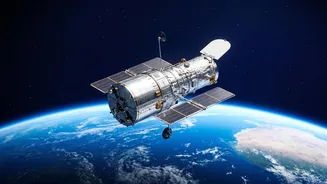
we have built bigger and better telescopes to peer into the cosmos. But what if the greatest observational tool wasn't something we could build, but something we could use? This is the core idea behind the Solar Gravitational Lens (SGL) concept, a proposal being seriously studied by scientists at NASA's Jet Propulsion Laboratory (JPL) and other institutions. The concept proposes turning our entire sun into a lens for a telescope. Instead of relying on mirrors and glass, it would leverage the immense gravity of our star to bend and magnify the light from distant objects, particularly exoplanets. If successful, a mission to this 'gravitational frontier' could deliver images of planets hundreds of light-years away with a resolution of just a few kilometers per pixel. This would be a monumental leap, potentially allowing us to see surface features like oceans, continents, and signs of habitability on these alien worlds.
Einstein's Gift to Stargazers
The science behind the SGL comes directly from Albert Einstein's theory of general relativity. He predicted that massive objects, like stars, warp the fabric of spacetime around them. This curvature doesn't just affect planets; it also bends the path of light. This effect, known as gravitational lensing, was first observed in 1919 and has since become a vital tool for astronomers to study distant galaxies. The SGL concept takes this a step further. As light from a faraway exoplanet passes by our sun, the sun's gravity bends the rays, causing them to converge at a focal point far beyond Pluto. If we place a spacecraft at this precise point, it could capture that focused light. The light from the target object appears as a bright circle around the sun, known as an 'Einstein ring'. A specialized algorithm could then reconstruct that distorted ring of light into a clear, detailed image of the planet's surface.
A Journey to the Edge of the Solar System
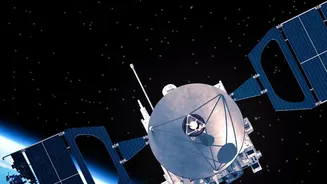
The primary challenge of an SGL mission is the immense distance involved. The focal point, where a telescope would need to be positioned, begins at a staggering 550 astronomical units (AU) from the sun—one AU is the distance from the Earth to the sun. To put that into perspective, Pluto is about 40 AU away, and the Voyager 1 spacecraft, humanity's most distant object, is only now at about 160 AU after more than 45 years of travel. Reaching the SGL's focal region, which extends outwards from 550 AU, is a monumental undertaking. Proposed solutions involve advanced propulsion technologies like massive solar sails, which would use the pressure of sunlight to accelerate a spacecraft to incredible speeds after a 'sun-skimming' maneuver. Even with such technology, the journey is estimated to take around 20 years. The mission would likely involve a fleet of smaller, more cost-effective satellites flying in formation.
What We Could See and Why It's Hard
The potential payoff is revolutionary: images of an Earth-like planet with a resolution of 10-25 kilometers, enough to distinguish surface features and analyze its atmosphere for signs of life. This is a thousand times more powerful than the best imaging technology currently available. However, the technical hurdles are as immense as the distances. The spacecraft must maintain a perfect alignment with the sun and its target exoplanet. Furthermore, the light from the exoplanet is quadrillions of times dimmer than our sun, requiring an unprecedentedly effective coronagraph—a device to block the sun's blinding glare. Scientists also have to contend with noise from the sun's own corona, the hot plasma that surrounds it, which can interfere with the faint signal from the exoplanet. Recent studies have even highlighted how variable cloud cover on a target planet could make it difficult to resolve a clear image of its surface. Despite these challenges, researchers believe they are engineering problems that can be solved.