





A Unique Celestial Pair
The object at the heart of this discovery is known as IRAS 18293-0941. First catalogued in the 1980s, it remained a mystery for decades, shrouded by a thick veil of interstellar dust. Recent observations, however, have peeled back the layers to reveal
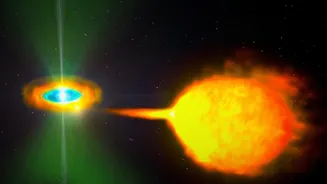
something extraordinary. This is not a single star but a binary system, a celestial dance between two powerful objects. One is a massive, hot star, and the other is a black hole with a mass about 10 times that of our Sun. The two are locked in a tight embrace, orbiting their common centre of mass every 11 days. This gravitational tango is the engine for the spectacular phenomena that astronomers have now observed.
The Jet Pointed Our Way
In this cosmic pairing, the black hole's immense gravity strips material from its larger companion star. This stolen gas and dust forms a swirling, super-heated accretion disk around the black hole. While much of this material is consumed, some is violently ejected back into space in the form of two powerful, narrow jets of plasma that shoot out from the black hole's poles. What makes IRAS 18293-0941 so compelling is the orientation of these jets. One of them is pointed almost directly towards Earth, racing through space at an incredible 75% of the speed of light. Researchers have been quick to reassure the public that despite its alarming trajectory, the jet poses no danger to our planet. At a distance of approximately 12,000 light-years, its energy dissipates long before reaching us, making it a subject of scientific fascination, not fear.
Our Galaxy's First Microblazar?
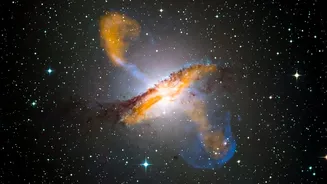
This special alignment earns IRAS 18293-0941 the title of a 'microblazar' candidate. To understand what that means, we first have to look at blazars. Blazars are enormous, distant galaxies powered by supermassive black holes millions or billions of times the mass of our sun. Their jets, which also happen to be pointed toward Earth, are so bright they can be seen across the universe. A microblazar is a scaled-down version of this phenomenon found within our own galaxy. It features a much smaller, stellar-mass black hole, but follows the same principle: it's a jet-producing system aimed in our direction. For decades, astronomers predicted such objects should exist in the Milky Way, but finding a convincing candidate has been elusive until now. IRAS 18293-0941 is the strongest contender yet for the title of our galaxy's first confirmed microblazar.
A Cosmic Laboratory Next Door
The discovery is a massive breakthrough for astrophysics. Having a microblazar within our own galaxy provides an unparalleled opportunity for study. While giant blazars are millions of light-years away, this object is practically in our galactic neighbourhood. It serves as a natural laboratory for studying some of the most extreme physics in the universe up close. Scientists hope to learn more about how black holes accelerate particles to near light speed and how their powerful jets interact with the surrounding gas and dust. The system may even hold clues to the origin of some of the ultra-high-energy cosmic rays that constantly bombard Earth's atmosphere, a long-standing cosmic mystery. Uncovering this object required the combined power of multiple observatories, including the MeerKAT radio telescope array, to pierce through the dense dust that kept it hidden for so long.