



A 'Big Bang' From Billions of Kilometres Away
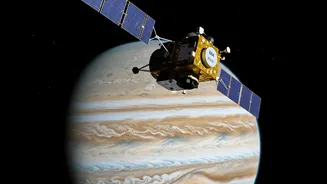
In early August 2026, engineers at NASA’s Jet Propulsion Laboratory pulled off a maneuver nearly half a century in the making. They sent a series of commands to Voyager 2, a probe currently navigating the vast emptiness of interstellar space over 21 billion
kilometres away. The mission, nicknamed the 'Big Bang' by the team, involved simultaneously shutting down non-essential hardware and switching to lower-power alternatives. This delicate, high-stakes operation was designed to free up a precious few watts of power. It was a risky move with no room for error; a single command takes nearly a full day to reach the spacecraft, and another day for a response to return. The effort was a success, buying the probe's scientific mission at least one more year of operation and avoiding the imminent shutdown of one of its last working instruments.
The Slow Fade of a Nuclear Battery
The need for such drastic measures comes down to simple physics. Both Voyager probes are powered by radioisotope thermoelectric generators (RTGs), which convert heat from decaying plutonium into electricity. It was a brilliant solution for a mission designed to last decades, but the power supply is finite. Every year, the RTGs produce about four fewer watts of power, forcing mission controllers into a long, slow process of triage. Over the decades, and especially since 2024, instruments have been powered down one by one. First went the cameras after the grand tour of the outer planets, then other specialised sensors no longer essential for the interstellar phase of the mission. Power margins have become, as NASA officials describe them, 'razor thin', making every watt a critical resource to be managed.
The Last Three Witnesses
Of the ten science instruments Voyager 2 launched with in 1977, only three remain operational. But these aren't just any three; they are the perfect tools for exploring the space between stars. The Cosmic Ray Subsystem (CRS) detects energetic particles, the Plasma Wave Subsystem (PWS) listens to plasma oscillations, and the Magnetometer (MAG) measures magnetic fields. This trio works together to paint a picture of an environment humanity has never directly sampled before. While its twin, Voyager 1, is further away, it has only two of these instruments still working. This makes Voyager 2's data, particularly from its Cosmic Ray Subsystem, unique and irreplaceable. These instruments are no longer sightseers; they are a remote field station for galactic science.
First Draft of Galactic Geography
So, what makes the data from these aging instruments so valuable? Voyager 2 crossed the heliopause—the boundary where the sun's influence gives way to the interstellar medium—in November 2018. It is now providing the first direct measurements of the density, temperature, and pressure of this new frontier. The Voyagers have confirmed that the interstellar plasma is denser and colder than the plasma within our solar system's bubble. They are discovering how our sun's protective bubble, the heliosphere, interacts with the wider Milky Way galaxy. Having two probes in different locations allows scientists to distinguish between localized phenomena and characteristics of the broader region, giving us a crude but vital 3D understanding of our cosmic shoreline. Without Voyager 2, we would not know if what Voyager 1 found was an anomaly or the norm.
A Legacy Measured in Light-Hours
NASA engineers hope their power-saving ingenuity can keep the probes talking to the Deep Space Network until the 2030s. But eventually, the power will fade completely, and the signals will cease. The final messages from Voyager 2 will mark the end of an era, but not the end of its journey. With no friction in deep space to slow them down, the probes will continue drifting through the Milky Way for millions of years, carrying their Golden Records as silent ambassadors from a distant, long-gone civilization. Every extra year they remain active is a bonus, an unexpected return on an investment made decades ago, providing priceless data that rewrites textbooks and expands our understanding of our place in the universe.