







What is a Stellar Black Hole?
Before diving into the jet, let's clarify what we're talking about. A stellar-mass black hole is born from the explosive death of a massive star. Despite their name, they aren't cosmic vacuum cleaners. Instead, they are objects with such intense gravity
that nothing, not even light, can escape once it crosses a boundary called the event horizon. The black hole currently under investigation, part of a system named IRAS 18293-0941, is about 10 times the mass of our Sun and is located safely in our Milky Way galaxy, roughly 12,000 light-years away. It is part of a binary system, meaning it's locked in a gravitational dance with a companion star.
Cosmic Jets Explained
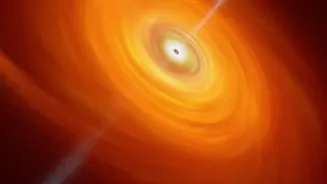
So, what are these jets? They aren't unique to this black hole. When a black hole has a companion star, it can pull material from that star into a swirling, superheated disc around itself, called an accretion disk. While much of this material falls into the black hole, a portion of it gets channelled by powerful magnetic fields and blasted out from the poles in two narrow, opposing beams. These beams, known as relativistic jets, are streams of plasma—ionised gas—that travel at a significant fraction of the speed of light. The jet from IRAS 18293-0941 is estimated to be moving at about 75% of light speed.
A 'Microblazar' Pointed at Us
When a jet from a supermassive black hole at the center of a distant galaxy is pointed towards Earth, astronomers call it a 'blazar'. This new discovery is being called a 'microblazar' because it involves a much smaller, stellar-mass black hole within our own galaxy. The reason it appears so bright to us is due to an effect called relativistic beaming, or Doppler boosting. Much like the siren of an ambulance sounds higher-pitched as it moves towards you, the light from a jet moving towards Earth appears dramatically brighter. This makes the Earth-facing jet from IRAS 18293-0941 appear luminous, while its twin, shooting out in the opposite direction, is much harder to see.
A Golden Opportunity for Science
The key takeaway for us on Earth is that this is not a threat. At 12,000 light-years away, the jet poses no danger. For scientists, however, this is a thrilling discovery they have been seeking for over 30 years. It provides a rare, close-up (in cosmic terms) laboratory for studying how black holes launch these incredibly powerful jets. Scientists are particularly interested in how these jets transfer enormous amounts of energy into their surrounding environment. The second, opposing jet from this system is slamming into a nearby cloud of interstellar gas, creating a massive bubble nearly 100 light-years wide and generating high-energy gamma rays, giving astronomers a unique view of the jet's power and impact.
How Astronomers Are Studying It
Detecting this microblazar was a feat of modern astronomy. The system was first catalogued decades ago but remained largely forgotten, hidden behind a thick veil of interstellar dust. Its true nature was revealed when astronomers noticed a tiny, periodic flicker in its brightness. This clue led to follow-up observations using an array of powerful radio telescopes, including the Very Long Baseline Array and South Africa's MeerKAT telescope. By combining radio data with precise measurements from the European Space Agency's Gaia satellite, an international team of researchers confirmed they were looking at a jet-producing black hole system within our own galaxy, aimed right in our direction.