






The Heartbeat of Our Planet
To understand the latest discovery, we first need a quick journey to the centre of the Earth. Our planet is structured in layers: a solid crust, a rocky mantle, a liquid outer core, and a solid inner core. The star of our story is the outer core, a 2,260-kilometre-thick
layer of superheated, liquid iron and nickel. This turbulent ocean of metal is in constant motion. As this electrically conductive fluid swirls and flows, it acts like a colossal dynamo, generating the magnetic field that envelops our planet. This field is not just a curiosity for compasses; it is a vital shield, deflecting harmful solar radiation and protecting our atmosphere, which makes it fundamental to life on Earth.
Our Eyes in the Sky
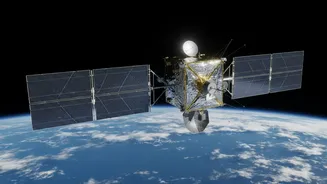
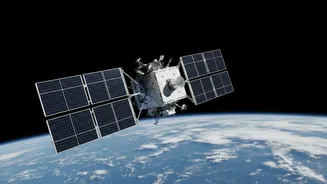
But how do we observe something happening more than 2,800 kilometres below the surface? The answer lies in space. We listen indirectly. Missions like the European Space Agency's (ESA) trio of Swarm satellites are equipped with highly sensitive instruments called magnetometers. Launched in 2013, these satellites fly in precise orbits, constantly measuring the strength and direction of Earth's magnetic field with exceptional accuracy. By carefully mapping the magnetic field, scientists can detect tiny fluctuations. These variations are like fingerprints left on the surface by the slow-moving currents of the deep interior, allowing researchers to create models of the flow within the liquid outer core.
A Sudden and Surprising Reversal
For years, analysis of this data suggested that much of the outer core's flow was generally moving in a westward direction. However, recent studies combining nearly three decades of satellite and ground observations have revealed a dramatic and unexpected event. Around 2010, a huge river of molten iron, located deep beneath the Pacific Ocean, abruptly changed direction. This large region, which had been flowing weakly westward, suddenly began moving strongly to the east. This reversal challenges the long-held assumption that changes in the core's large-scale flow happen only gradually over very long periods. This shows the system can be far more dynamic than previously believed, with regional changes emerging in just a decade.
What Caused the Shift?
The short answer is that scientists are not entirely sure, but they have intriguing clues. The event has raised new questions about the complex dynamics at play in Earth's deep interior. Some researchers hypothesize that the reversal could be part of a repeating natural cycle or a short-term fluctuation. More recent data from the Swarm mission suggests the eastward surge has already begun to weaken since its peak around 2020. There is also speculation about a connection to Earth's solid inner core. The reversal event in the outer core happened around the same time that other studies, using different methods, suggested a change in the inner core's behaviour. This hints at a complex dance between Earth's different layers.
Why This Matters for Us
While these events are happening thousands of kilometres below us and pose no immediate danger, they are fundamentally important. Understanding the geodynamo is crucial because the magnetic field it generates is constantly, albeit slowly, changing. These changes can affect modern life, influencing everything from satellite navigation systems and spacecraft operations to models of space weather that help protect our power grids. By studying these rapid, unexpected changes, scientists can refine their models of the Earth's interior. This knowledge helps us not only to understand the long-term evolution of our planet and its protective magnetic shield but also to better forecast its behaviour in the future.