




Uncovering a Geological Ghost
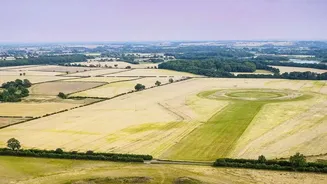
There are no mountains or craters to give the game away. The volcano, now named the Wash Igenous Complex, is completely invisible, buried deep beneath hundreds of millions of years of rock and sediment. So how did scientists find it? The discovery was
a masterclass in geological detective work. Researchers from the British Geological Survey and the University of Oslo revisited rock samples that had been collected from deep boreholes in Norfolk and Lincolnshire decades ago. Using modern technology, they analysed tiny zircon crystals, smaller than the width of a human hair, found within these samples. These crystals form in magma and contain uranium, which decays into lead over vast timescales. By measuring the ratio of these elements, scientists created a precise geological clock, dating the crystals—and the volcanic eruption that created them—to 454.4 million years ago.
Solving a Scandinavian Mystery
The discovery does more than just identify a hidden feature of the English landscape; it solves a long-standing European mystery. Across Scandinavia and the Baltic region, geologists have long been puzzled by a thick layer of ancient volcanic ash known as the Kinnekulle tephra. The sheer size of this deposit suggested a massive eruption, but its source was unknown. The dating of the English volcano provided the crucial link. The age of the zircon crystals, 454.4 million years, is a near-perfect match for the age of the Kinnekulle ash layer. Chemical similarities in other minerals further strengthened the connection. This compelling evidence suggests that the volcano beneath England was responsible for the enormous ash cloud, which drifted across a now-vanished sea and settled across what would become Northern Europe.
A Journey to a Lost World
To understand this volcano, you have to imagine a completely different planet. During the Late Ordovician period, 454 million years ago, the continents were in unfamiliar positions. The land that would become England was part of a microcontinent called Avalonia, which was drifting northwards. It was separated from the continent of Baltica (ancient Scandinavia) by the Tornquist Sea. Avalonia was a volcanically active zone, sitting on the edge of a tectonic plate in a process similar to the Pacific's 'Ring of Fire' today. The landscape would have been rugged and volcanic, a stark contrast to the rolling hills and gentle coasts of modern England. The eruption itself was cataclysmic, estimated to have thrown hundreds of cubic kilometres of ash and rock into the stratosphere with a force comparable to thousands of powerful bombs.
Why This Ancient Volcano Matters Today
While the volcano is long extinct and poses no threat, its discovery is hugely significant. It provides a powerful new data point for understanding the geological formation of Britain and Europe. The event was part of a major mountain-building period, the Caledonian Orogeny, which fused different landmasses together to eventually form the British Isles. The re-analysis of old borehole samples highlights the value of geological archives, showing how decades-old material can yield new secrets with advanced analytical techniques. It’s a vivid reminder that the ground beneath our feet is a library of Earth's dramatic and fiery history, with entire worlds buried just out of sight. The volcano may be gone, but its story is rewriting our understanding of the deep past.