



The Alluring 'Lifeboat' Theory
Elon Musk has consistently argued that for humanity to ensure its long-term survival, it must become a multi-planetary species. He envisions a self-sustaining city on Mars as a crucial 'lifeboat' should a catastrophe — whether a pandemic, asteroid strike,
or self-inflicted disaster — render Earth uninhabitable. In recent statements, he clarified that while Mars wouldn't be immune to Earth's problems, the immense difficulty of travel would act as a buffer, offering a "six-month quarantine" against a pandemic, for example. This idea of preserving the flicker of consciousness is seductive. It frames Mars colonization not merely as exploration but as an essential act of existential preservation. However, this grand vision crumbles when scrutinized against the unforgiving laws of physics and biology that govern Mars.
An Atmosphere That Kills
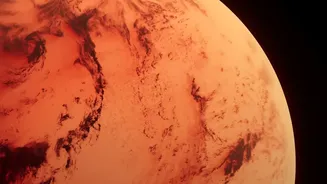
The first and most immediate barrier to life on Mars is its atmosphere — or lack thereof. The Martian atmosphere is about 100 times thinner than Earth's and is composed of 95% carbon dioxide. Exposure to this environment would be instantly fatal. The low pressure would cause a person's blood to essentially boil, a gruesome process called ebullism. You couldn't take a breath, and even if you could, the air is unbreathable. This means any human presence would be entirely dependent on flawlessly sealed habitats and pressurised suits. Unlike a damaged Earth where you could still, in theory, walk outside, a single habitat breach or suit tear on Mars would mean death in minutes, making the 'safety net' extraordinarily fragile.
A Ceaseless Rain of Radiation
On Earth, a robust magnetic field and thick atmosphere shield us from the vast majority of harmful cosmic and solar radiation. Mars has neither. This leaves its surface exposed to a constant bombardment of high-energy particles that shred DNA and wreak havoc on biological systems. Astronauts on a round trip to Mars could be exposed to radiation equivalent to dozens of CAT scans, dramatically increasing their lifetime risk of cancer, cataracts, and damage to the central nervous system. Living on the surface would mean accumulating a dangerous dose over time. While habitats could be shielded by being buried under feet of Martian soil (regolith), this creates a psychological challenge of subterranean living and doesn't solve the risk for any surface exploration or work. The radiation problem is a slow, invisible killer that no amount of pioneering spirit can wish away.
The Triple Threat: Dust, Cold, and Isolation
Beyond the big-ticket killers of air pressure and radiation, daily life on Mars would be a struggle against a hostile landscape. The average temperature hovers around a deadly minus 62 degrees Celsius. The planet is also covered in a fine, toxic dust containing chemicals like perchlorates and silica. This dust is not just an irritant; it's a chronic health hazard that can cause lung damage, interfere with thyroid function, and contaminate everything. Furthermore, the psychological toll of being millions of miles from Earth, with communication delays of up to 20 minutes, cannot be overstated. The profound isolation, combined with the constant stress of living in a life-or-death environment, poses a significant and often underestimated threat to the success of any long-term mission.
The Myth of Self-Sufficiency
For Mars to be a true backup, a colony must be completely self-sufficient. This remains a technological fantasy. Growing enough food to feed a population would be a monumental challenge. The Martian soil is toxic and lacks organic nutrients, meaning all agriculture would need to happen in highly complex, closed-loop hydroponic or aeroponic systems that have never been deployed at such a scale. Extracting and purifying water from ice, generating breathable oxygen from the CO2-rich atmosphere, and producing all necessary power, spare parts, and medicine locally are challenges that are far from being solved. A colony that cannot survive if the resupply ships from Earth stop coming, as Musk himself has identified as the key test, isn't a safety net; it's a remote outpost on life support, with the plug millions of miles away.