



A Trio of Cosmic Dancers
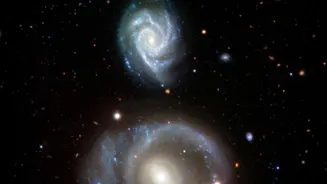
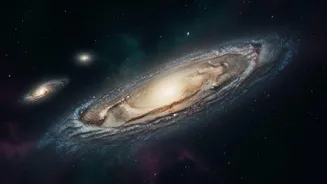
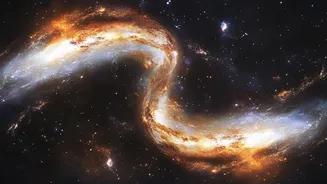
One stunning image from the Hubble Space Telescope captures a scene that seems to pulse with energy: a trio of galaxies known collectively as NGC 7764A. Located approximately 425 million light-years away, two of the galaxies in the upper right of the frame
are clearly in the middle of a slow-motion merger. Their shapes are distorted, with long trails of gas and stars stretching into the void—a classic sign that their mutual gravity is tearing them apart and reshaping them over millions of years. A third, spherical galaxy sits nearby, looking like a bowling ball on the verge of striking the other two. The immediate impression is of a chaotic, three-way galactic pile-up. But in the vastness of space, our earthbound perspective can be profoundly deceptive.
The Illusion of Proximity
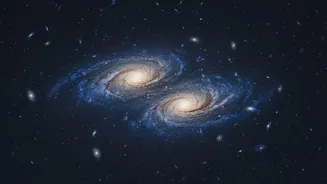
The universe is not a flat canvas; it is a three-dimensional expanse of almost incomprehensible depth. When we look at a telescope image, we are seeing a 2D projection of that 3D space. This can create powerful optical illusions known as "chance alignments" or "line-of-sight alignments." It's the same effect you see when you hold your thumb up to the sky and make it look like you are pinching the moon. Your thumb and the moon appear to be in the same spot, but one is an arm's length away while the other is hundreds of thousands of kilometres away. Astronomers constantly grapple with this challenge. Just because two galaxies appear side-by-side in an image does not mean they are cosmic neighbours. They could be separated by tens of millions of light-years, with one galaxy simply located in the distant background of the other from our specific vantage point on Earth.
How Astronomers Tell the Difference
So, how do scientists determine if galaxies are truly interacting or just ships passing in the night? They look for evidence beyond the initial visual. The primary clue is gravitational distortion. When massive galaxies merge, their immense gravity warps their structures long before they actually touch. If a galaxy appears perfectly formed despite being visually overlapped by another, it's likely a background object. The most definitive evidence comes from measuring the galaxies' movement and distance. By analyzing the light from a galaxy, astronomers can determine its redshift—a phenomenon where light from receding objects shifts toward the red end of the spectrum. The greater the redshift, the faster the galaxy is moving away from us, and generally, the farther away it is. If two galaxies in an image have vastly different redshifts, it confirms they are not physically connected. In the case of NGC 7764A, the two distorted galaxies are indeed partners in a cosmic dance, while the third's connection is less certain—it might be a true companion or just a photobomber.
More Than Just a Pretty Picture
These chance alignments are far more than just cosmic curiosities. They provide unique scientific opportunities. A prime example is the galaxy pair NGC 3314. In Hubble images, these two galaxies appear to be in the midst of a spectacular collision, but they are actually separated by tens of millions of light-years. However, this alignment gives astronomers a perfect backlit view. The stars of the background galaxy, NGC 3314B, illuminate the intricate, swirling dust lanes of the foreground galaxy, NGC 3314A, in silhouette. This allows scientists to study the distribution and properties of interstellar dust in a way that would be impossible if the galaxy were seen against the blackness of empty space. The illusion, in this case, becomes an invaluable research tool.
The Ultimate Cosmic Mirage
An even more mind-bending version of misleading perspectives comes from gravitational lensing. This occurs when a massive object, like a galaxy cluster, has so much gravity that it literally bends the fabric of spacetime around it. Light from a more distant object traveling past this cluster follows the curved path, much like light passing through a lens. In 2023, the James Webb Space Telescope captured an astonishing example of this: an image containing three distinct views of the exact same supernova-hosting galaxy. The galaxy cluster RX J2129, acting as a cosmic magnifying glass, created multiple images of the background galaxy. Because the light for each image traveled a different path through the cluster, the images even show the galaxy at different points in time, allowing astronomers to watch the supernova fade across the three apparitions.