



A Cosmic Mystery Solved
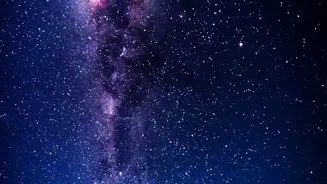
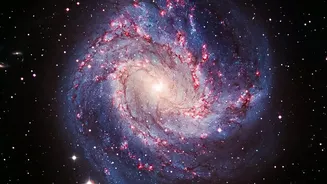
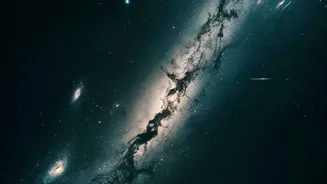
For years, astronomers have been puzzled by a strange feature of our galaxy. While the stars in the main, flat disc of the Milky Way orbit the galactic centre at a brisk 220 kilometres per second, the stars in the sparse, spherical cloud surrounding it,
known as the stellar halo, move much more slowly. This discrepancy suggested something dramatic happened in our galaxy's distant past. New research presented at the Royal Astronomical Society's National Astronomy Meeting provides a compelling answer: a cataclysmic crash with a dwarf galaxy didn't just rattle the Milky Way; it completely flipped its orientation.
The Prime Suspect: A Sausage-Shaped Galaxy
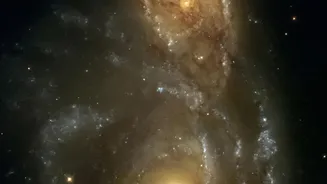
The culprit in this galactic hit-and-run is a dwarf galaxy known to astronomers as Gaia-Sausage-Enceladus (GSE). The unusual name comes from the sausage-like shape of the orbits of its former stars, which were discovered using data from the European Space Agency's Gaia space telescope. This massive dwarf galaxy, with a total mass more than 10 billion times that of our sun, slammed head-on into a young Milky Way approximately 10 to 11 billion years ago. Our much larger galaxy tore GSE to shreds, absorbing its stars and gas. But the impact was so violent that it set in motion a gradual, yet monumental, shift in the Milky Way's posture.
Reading the Galactic Scars
Scientists at Durham University used powerful supercomputer simulations to piece together this ancient event. By modeling the evolution of galaxies similar to our own, they found that galaxies with slow-moving stellar halos almost always had two things in common: they had experienced a major head-on collision, and their main disc had subsequently 'flipped' by more than 90 degrees. This process wasn't instantaneous. Lead researcher Kirill Batrakov estimates it likely took hundreds of millions, or even up to two billion years, for the gravitational forces to gradually reorient the entire galactic disc into the position we see today. The slow-moving halo is essentially the lingering evidence of this ancient chaos, a 'smoking gun' proving that the collision happened.
What This Means for Our Place in the Universe
This discovery fundamentally changes how we view our galaxy's history. It suggests the Milky Way was not built peacefully but was shaped by violent, transformative events. The collision with GSE is now considered the most significant merger in our galaxy's early history, responsible for creating the 'bulge' at the galactic centre and scattering debris throughout the stellar halo. The finding implies that everything within the galaxy, including our own Sun and solar system, once moved on a completely different path through the cosmos. It also helps explain another oddity: recent studies have shown that the Milky Way’s vast, invisible halo of dark matter appears to be tilted almost perpendicularly to the stellar disc, a misalignment that a disc flip could elegantly explain.