


The Classic Story of the Moon's Birth
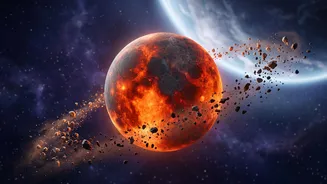
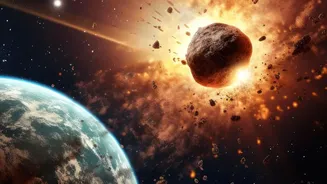
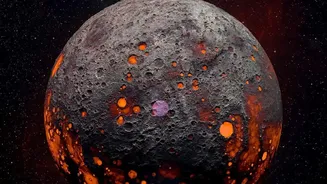
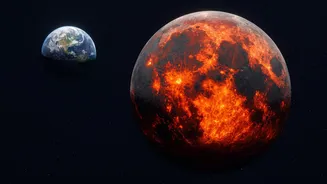
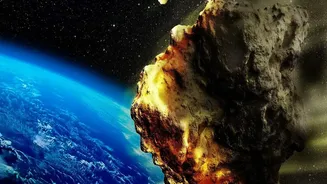
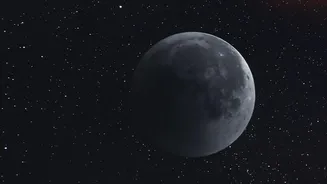
For decades, the leading scientific theory for the Moon's creation has been the "Giant-Impact Hypothesis". This idea, first proposed in the 1970s, suggests that about 4.5 billion years ago, a young, developing Earth was struck a glancing blow by a Mars-sized
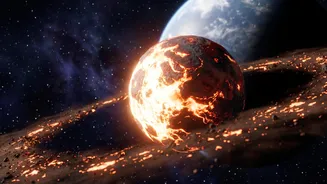
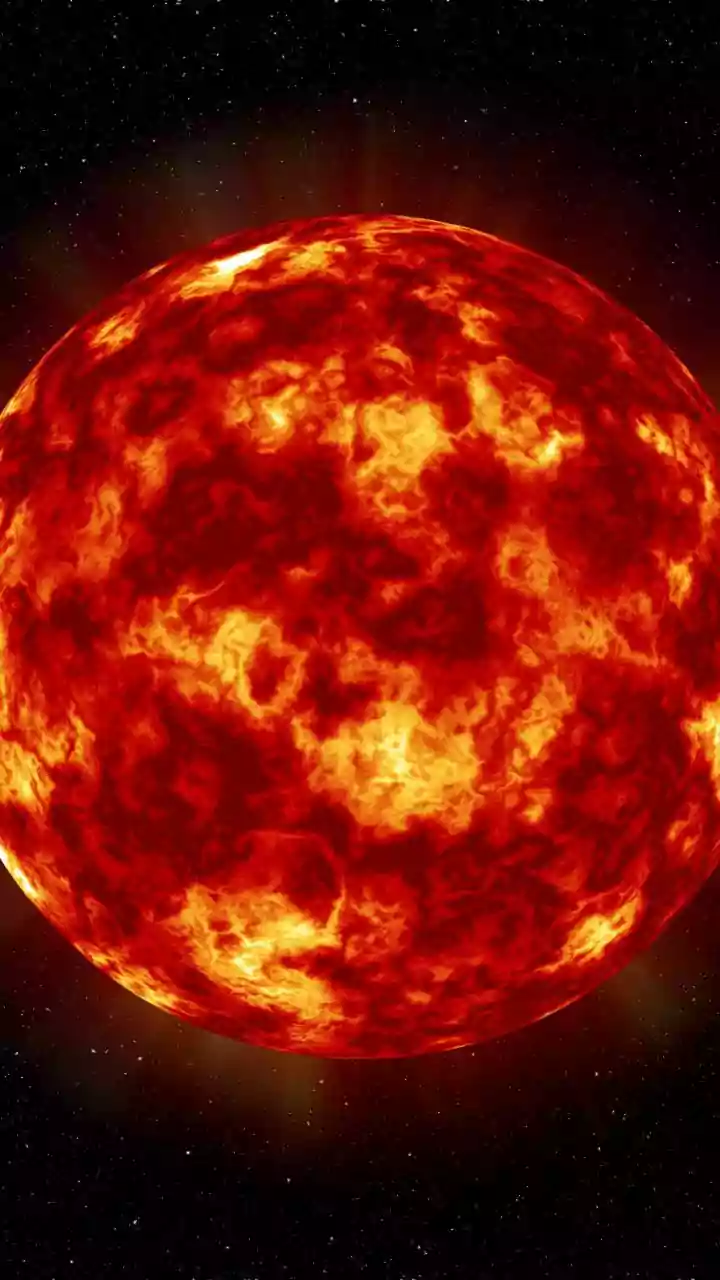
planet, which scientists have nicknamed Theia. The colossal collision would have sent a massive cloud of molten rock and debris into orbit around our planet. Over a long period, potentially months or even years, this debris ring is thought to have slowly clumped together, or accreted, to form the Moon we see today. This theory neatly explained many things, like the Moon's size and orbit, but it has always had a few nagging problems.
A New, Faster Timeline Emerges
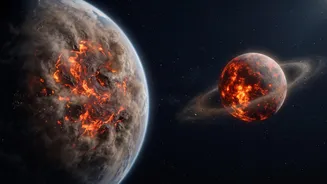
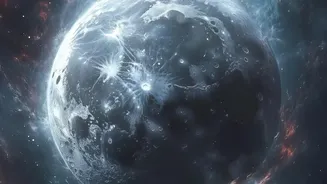
Recent supercomputer simulations are now challenging that slow-and-steady formation story. Scientists from institutions including Durham University and NASA ran incredibly detailed models of the ancient collision. What they found was stunning: under certain conditions, a large, stable satellite—a proto-Moon—could be launched directly into orbit within a matter of hours. In one simulation, a body very much like our Moon formed in as little as five hours after Theia’s impact. This "immediate-satellite scenario" suggests the Moon might have been born not from a slow gathering of dust, but in a single, dramatic event.
Why the New Model Matters
This rapid-birth theory isn't just exciting because it's fast; it also helps solve a major puzzle that has long stumped scientists. When Apollo astronauts brought back lunar rocks, analysis showed their chemical makeup was surprisingly similar to rocks from Earth's mantle. If the Moon formed mostly from the debris of Theia, as the older models suggested, it should look chemically different. However, a high-speed, single-stage formation event would have thrown a much larger chunk of Earth's own material into the mix, particularly in the Moon's outer layers. This could elegantly explain why Earth and Moon rocks are such close chemical cousins.
What Did the Computers Show?
The breakthrough came from using simulations with much higher resolutions than ever before, capable of modeling the event down to a particle level. These powerful models, run on supercomputers like the DiRAC facility in the UK, allowed researchers to include factors like the material strength and temperature of the colliding planets. They discovered that if Theia and the early Earth were treated as solid geological bodies rather than simple strengthless spheres, the outcome of the impact could change dramatically. In scenarios where the planets were hotter and more deformable, they were more likely to create a debris disk. But in other simulations, a mostly-intact chunk of Theia was captured in orbit, creating a proto-Moon almost instantly.
So, Is the Case Closed?
Not quite. It's important to remember that this is a powerful new theory based on computer modeling, not a definitive final answer. The scientists themselves are clear that they have not proven the Moon formed in five hours, but have shown that it is a physical possibility that opens up a whole new range of scenarios for the Moon's evolution. This rapid-formation theory does a better job of explaining some of the Moon's mysteries, such as its tilted orbit and thin crust. To get closer to the truth, scientists will need to analyze new lunar samples, which they hope to collect during NASA's upcoming Artemis missions. These future missions could provide the ground truth needed to confirm which incredible birth story our Moon truly had.