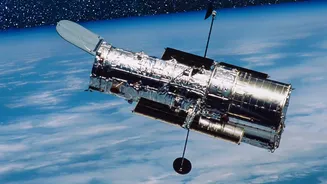







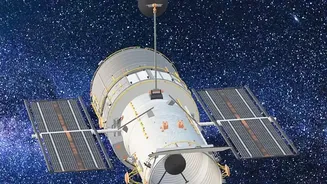
How do you name a spacecraft designed to clean up Earth's orbit? The UK Space Agency turned to the public for its first-ever Active Debris Removal mission, a pioneering effort to tackle the growing problem of space junk.
A Mission to Clean the Cosmos
The UK Space Agency is embarking
on its first national mission to actively remove space debris from orbit. This groundbreaking initiative, officially called the UK Active Debris Removal (UK ADR) mission, aims to address the increasing hazard posed by defunct satellites and other human-made objects cluttering the space around our planet. In a bid to engage the public, the agency launched a competition for UK residents to name the mission's spacecraft. The contest, which closed in December 2026, invited people to propose a name that reflects the goal of creating a safer and more sustainable space environment for future generations. As an added incentive, the agency noted that the winning entry might be etched onto the side of the actual spacecraft.
The Growing Threat of Space Junk
Low Earth Orbit is becoming dangerously crowded. There are thousands of operational satellites that provide essential services we rely on daily, from GPS navigation and weather forecasting to global communications and financial transactions. However, these are accompanied by a growing cloud of debris: old satellites, discarded rocket stages, and fragments from past collisions. These objects travel at incredible speeds, with some reaching over 17,000 miles per hour. A collision with even a small piece of debris can cripple or destroy a functioning satellite, potentially triggering a chain reaction of further collisions that could render entire orbital paths unusable. This mission is the UK's proactive step towards mitigating that risk.
Enter the 'Claw': How It Works
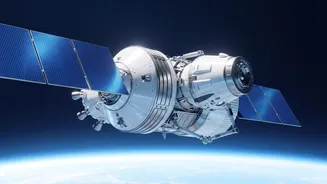
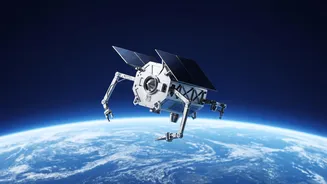
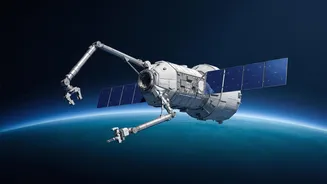
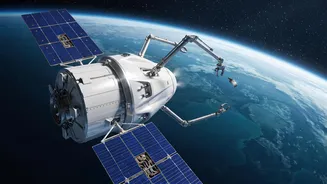
The UK ADR mission, scheduled for operations to begin in 2029, is a collaboration with the Swiss company ClearSpace. The mission will involve launching a specialised spacecraft designed to hunt down and capture two defunct, UK-registered satellites. The spacecraft will use advanced autonomous navigation to rendezvous with its targets. Once in position, it will use a set of robotic arms, often described as giant claws, to securely grab onto the derelict satellites, which were never designed to be handled in this way. After capturing a target, the spacecraft will drag it into a lower orbit, causing both to safely burn up upon re-entering Earth's atmosphere. This will be the first time a single mission has removed more than one piece of debris.
More Than Just a Cleanup
While the immediate goal is tidying up our orbital neighbourhood, the mission has broader ambitions. With a contract value of over £61 million, the project is a significant investment in the UK's space industry. The technologies being developed for this mission—including advanced robotics and autonomous proximity operations—are crucial for the future of in-orbit servicing. Successfully demonstrating these capabilities will position the UK as a leader in an emerging market that includes repairing, refuelling, and upgrading satellites directly in space. According to the UK Space Agency, this mission is not just about removing debris; it's about building the foundation for a new generation of space services and a sustainable circular economy in orbit.