




A Cosmic Collision Course
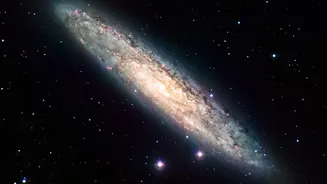
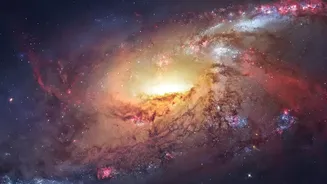
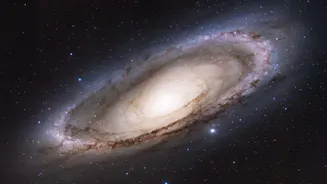
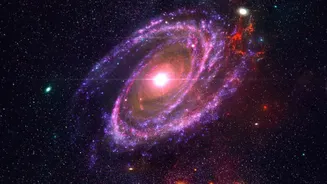
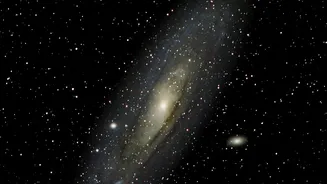
The Andromeda galaxy, also known as M31, is our closest major galactic neighbour, located about 2.5 million light-years away. Despite this vast distance, it is not stationary. Pulled by mutual gravity, the Milky Way and Andromeda are rushing towards each
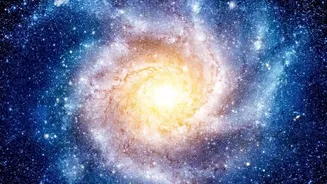
other at a staggering speed of roughly 110 kilometres per second. For years, astronomers have forecast that this trajectory will result in a direct merger in about 4.5 billion years. This future event, dubbed 'Milkomeda', would see the two spiral galaxies combine to form a new, giant elliptical galaxy. While the stars themselves are too far apart to likely collide, the gravitational upheaval would dramatically reshape our cosmic neighbourhood.
The Universe's Invisible Brakes
The story, however, is not as simple as two objects flying directly at one another. Both the Milky Way and Andromeda are encased in enormous, invisible halos of gas and dark matter. These halos are far larger and more massive than the visible, star-filled disks of the galaxies themselves. As Andromeda travels towards us, it plows through the outer parts of the Milky Way's halo. This journey through a sea of particles creates a drag effect known as 'dynamical friction'. Think of it as a form of gravitational wake; as Andromeda moves, its gravity pulls on the dark matter particles behind it, and that collective pull exerts a braking force, slowing the galaxy down. This friction is a key reason the two galaxies will eventually merge rather than potentially flying past one another.
A Surprising New Twist
Scientists have long factored dynamical friction into their models of the forthcoming merger. The assumption has been that this braking effect would be a gradual and steady process. However, the latest analysis of Hubble data suggests something different is happening. According to the new findings, the rate at which Andromeda is slowing down has recently increased. In other words, the cosmic brakes are being applied more forcefully now than they were in the more distant past. This indicates that the gravitational drag is stronger than previous models had predicted, forcing a re-evaluation of the forces at play between our two galaxies.
Why the Sudden Slowdown?
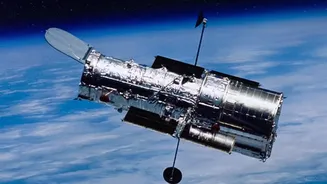
The most likely explanation for this accelerated slowdown is that the combined dark matter halo enveloping both galaxies is denser or more extensive than previously thought. Dynamical friction is highly dependent on the density of the medium a massive object is moving through. If Andromeda is now entering a richer, denser region of our shared galactic halo, it would naturally experience a stronger braking force. By precisely measuring the positions and motions of stars within Andromeda over many years, Hubble has allowed astronomers to detect this subtle but significant change in its velocity. This provides a powerful, indirect way to map the unseen dark matter that dominates our Local Group of galaxies.
What This Means for Our Future
An accelerated slowdown doesn't necessarily mean the collision is off, but it could alter the timeline and nature of the merger. A stronger braking force could mean the galaxies spiral into each other more quickly once the merger begins in earnest, though the initial contact date might not change significantly. More importantly, this finding provides a crucial new piece of data for understanding dark matter, the mysterious substance that makes up about 85% of the universe's mass but does not interact with light. By observing its gravitational effects on a grand scale, such as the braking of an entire galaxy, scientists can refine their theories about its properties and distribution. It's a reminder that even for an event billions of years in the future, new discoveries can change the script entirely.